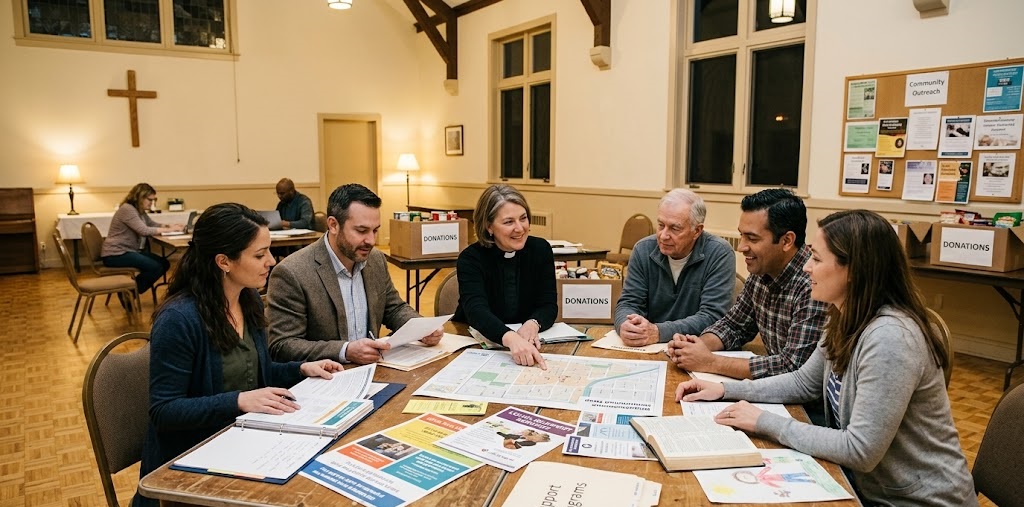
Local support systems rarely grow from one organization acting alone. They become stronger when churches, schools, nonprofits, civic leaders, volunteers, and families begin working from the same map. A food pantry may meet an immediate need. A school may identify families under pressure. A church may provide trusted space. A nonprofit may bring program experience. When those pieces connect, the community receives more than scattered help. It receives a network.
That is why community partnerships matter so much for local outreach. They help organizations move beyond one-time service and toward long-term stability, shared responsibility, and deeper trust. For faith-based organizations, this kind of collaboration also reflects a practical expression of service: seeing the whole person, not just the visible need.
Strong partnerships do not erase the identity of each organization. They make each partner more useful. A church can remain a church. A school can remain a school. A nonprofit can remain focused on its mission. But when they coordinate, they reduce gaps, avoid duplicated work, and help families find support before small challenges become emergencies.
Why Local Support Systems Need More Than Good Intentions
Good intentions are important, but they are not enough to build a dependable support system. Communities need structure. They need communication. They need shared goals. Without those elements, even generous outreach efforts can become fragmented.
Imagine three organizations trying to help the same neighborhood. One hosts a clothing drive. Another offers tutoring. A third provides emergency grocery assistance. Each effort is valuable. But if those groups never speak with one another, families may miss services, volunteers may be underused, and leaders may never see the full pattern of need.
Partnerships help turn isolated efforts into coordinated care. They allow organizations to ask better questions. Who is already serving this group? Where are families falling through the cracks? Which needs are seasonal, and which are ongoing? What resources exist nearby but remain disconnected?
This kind of coordination is especially important for churches and faith-based organizations. Many people turn to trusted local institutions first when they are facing financial stress, educational challenges, grief, housing insecurity, or family pressure. When those institutions are connected to a wider support network, they can respond with wisdom instead of guesswork.
That is the difference between activity and impact. Activity says, “We hosted an event.” Impact asks, “Did the right people receive the right help at the right time?”
The Power Of Shared Trust
Trust is one of the most valuable assets in community work. It cannot be rushed, purchased, or announced into existence. It grows when people see organizations keeping promises, listening carefully, and showing up consistently.
Churches often have deep trust within their communities because they are present through many seasons of life. Schools build trust through daily contact with children and families. Nonprofits build trust by delivering specialized services. Local businesses build trust by investing in the places where they operate.
When these groups partner well, they share more than resources. They share credibility.
For example, a family may feel more comfortable attending a financial literacy workshop if it is hosted at a familiar church. A school may be able to reach more parents if a local nonprofit helps with translation, transportation, or childcare. A nonprofit may gain stronger volunteer support when faith communities help spread the word.
This is why community support networks are so important. They allow local organizations to build a bridge between need and action. Instead of asking residents to navigate a confusing system alone, partnerships create warmer pathways into help.
The strongest partnerships are not built on publicity. They are built on respect. Each partner understands what the others bring, and no one treats collaboration as a way to control the whole effort.
What Strong Partnerships Actually Look Like
Not every partnership needs to be large or complicated. In many cases, the most effective collaborations are simple, focused, and consistent.
A church might offer space for after-school tutoring while a local educator designs the learning plan. A nonprofit might train volunteers while a neighborhood group recruits families. A school might identify student needs while a local business donates supplies. A health organization might provide screenings during a community workshop hosted by a faith-based group.
The key is alignment. Partners should know the purpose, the audience, the responsibilities, and the expected outcome before the work begins.
| Partnership Type | How It Strengthens Local Support |
|---|---|
| Churches and schools | Connect families with tutoring, mentoring, supplies, and trusted support |
| Nonprofits and volunteers | Expand service capacity while improving organization and training |
| Local businesses and charities | Provide funding, supplies, visibility, and workplace giving opportunities |
| Civic groups and faith organizations | Improve outreach, communication, and neighborhood-level coordination |
The best partnerships also include clear communication. That means regular check-ins, honest updates, and a willingness to adjust when something is not working. A partnership that never evaluates itself can become busy without becoming effective.
Strong collaboration also respects the dignity of the people being served. Community members should not be treated as projects. They should be treated as neighbors, contributors, and voices in the process.
Lessons From Tribal-State Cooperation
Community partnerships are not limited to churches and nonprofits. Larger public systems also show why cooperation matters. In Oklahoma, discussions around strong Tribal–state partnerships highlight how collaboration between governments can affect education, economic development, public policy, and long-term community well-being.
The lesson applies beyond Oklahoma. When institutions work with one another instead of around one another, the public benefit grows. That principle matters at every level, from state policy to neighborhood outreach.
Tribal Nations, local governments, schools, churches, and nonprofits all understand something important: communities are interconnected. A decision in one area can affect families in another. Education affects workforce opportunity. Health affects school attendance. Transportation affects access to food, work, and worship. Economic stability affects family stress.
Local support systems become stronger when leaders recognize those connections. A church organizing a school supply drive may also learn that families need transportation help. A nonprofit running a food program may discover that seniors need social connection. A volunteer group helping with home repairs may uncover deeper needs around safety, disability access, or caregiver support.
Partnerships help organizations respond to the whole picture. They make it easier to connect dots that one group might miss alone.
How Churches Can Build Better Community Partnerships
Churches and faith-based organizations do not need to wait for a perfect opportunity to begin. A strong partnership can start with one conversation.
The first step is listening. Before launching a new program, leaders should talk with school staff, nonprofit directors, neighborhood leaders, parents, and volunteers. What needs are they seeing? Which services already exist? Where is there duplication? Where is there a gap?
The second step is choosing focus. No organization can solve every problem. A church may decide to focus on youth mentoring, food support, caregiver encouragement, educational workshops, or volunteer mobilization. A clear focus makes it easier to choose the right partners.
The third step is defining roles. Confusion can weaken even a well-intentioned collaboration. Partners should know who manages communication, who recruits volunteers, who tracks attendance, who provides supplies, and who follows up with families.
A simple partnership plan should answer:
- Who are we serving?
- What need are we addressing?
- What will each partner contribute?
- How will we measure progress?
- How will we protect trust and dignity?
The final step is consistency. One event can be helpful, but repeated support builds reliability. Families are more likely to engage when they know a program will continue, volunteers are more likely to commit when expectations are clear, and partners are more likely to invest when they see steady results.
Measuring The Strength Of A Partnership
Community partnerships should feel compassionate, but they also need practical measurement. This does not mean reducing people to numbers. It means paying attention to whether the work is actually helping.
A church or nonprofit might track how many families attended a workshop, how many students received school supplies, how many volunteers returned for another project, or how many partner referrals led to real assistance. These numbers can reveal whether a program is reaching people effectively.
Still, the best measurement combines data with stories. A rising attendance number matters. But so does the parent who says a tutoring program helped their child regain confidence. A volunteer count matters. But so does the retiree who found purpose through weekly service. A donation total matters. But so does the family that avoided a crisis because support arrived at the right moment.
Strong partnerships create visible and invisible outcomes. They improve services, but they also build trust. They solve immediate problems, but they also strengthen the community’s ability to respond next time.
That is why the goal should not be partnership for its own sake. The goal should be better care, stronger relationships, and more resilient neighborhoods.
A Stronger Community Is Built Together
Local support systems become stronger when organizations stop asking, “What can we do alone?” and start asking, “What can we build together?”
For churches, this shift is deeply practical. Partnership allows faith communities to serve more wisely, reach more people, and connect compassion with structure. It also reminds the wider community that support is not only about programs. It is about relationships.
A strong partnership can help a child receive tutoring, a parent find encouragement, a senior feel less isolated, or a family discover support before a crisis deepens. Those outcomes may begin with a meeting, a shared calendar, a volunteer sign-up sheet, or a simple conversation between leaders who care about the same neighborhood.
When churches, nonprofits, schools, civic groups, and local residents work together, support becomes easier to find and harder to break. That is how communities grow stronger: not through one organization carrying every burden, but through many hands carrying the work with purpose.