Author: wpadmin

  • Accessibility

    Accessibility

    Imagine a classroom where every student can fully participate, engage, and succeed. This is the heart of modern education. It’s not just about ramps and elevators anymore. True learning equity means designing experiences that work for everyone from the very beginning.

    When we build with inclusive design in mind, we create a better, more flexible experience for all learners. Features like video captions, for example, help students focus and provide access in noisy environments or quiet libraries. This approach boosts engagement, improves knowledge retention, and leads to higher achievement across the board.

    This foundational principle is often called resource accessibility. It’s the cornerstone of a fair and effective educational system. Consider that roughly 15% of Americans live with a learning disability, highlighting the scale of potential exclusion without thoughtfully created accessible learning spaces.

    By embracing universal design, we move beyond seeing accommodations as an add-on. We start building learning that is inherently more powerful and equitable for every single person in the room.

    Designing Inclusive Content

    Inclusive content design makes learning easier for everyone. It starts with creating materials that are easy to use from the beginning. The SCULPT framework is a great tool for this. It helps you make content that supports educational accessibility well.

    SCULPT stands for six important principles: Structure, Colour contrast, Use of images, Links, Plain English, and Tables. Let’s look at each one with simple tips.

    • Structure

    Use proper heading tags (H1, H2, H3) to organize your content. Don’t just make text big and bold. Screen readers need this structure to help users.

    • Colour Contrast

    Make sure text and background have enough contrast. Avoid light grey text on white backgrounds. Good contrast helps those with low vision or color blindness.

    • Use of Images

    Every image should have descriptive alt text. Don’t leave alt text empty or use generic names. Good alt text helps those who can’t see the image.
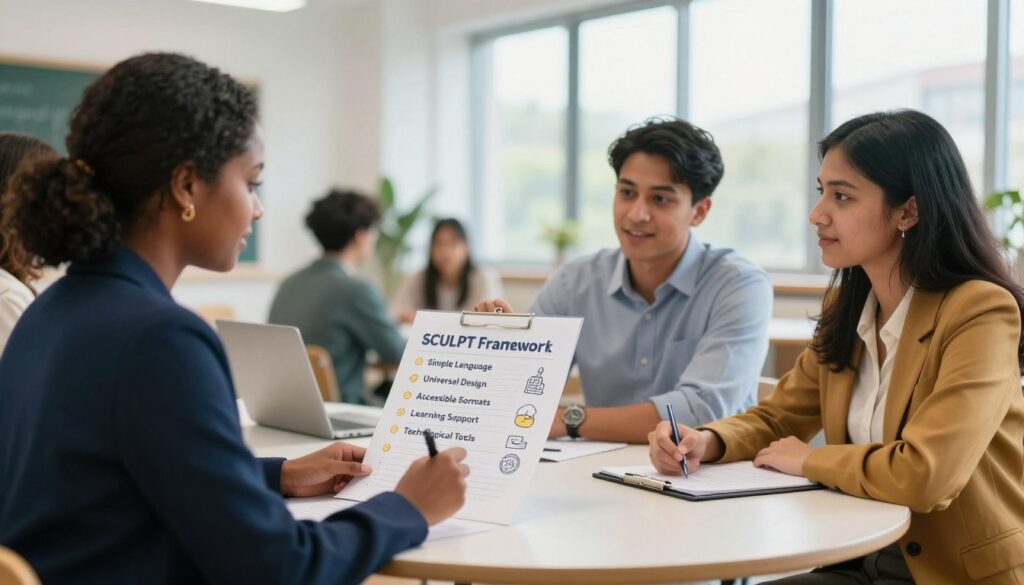
    SCULPT framework checklist for educational accessibility

    Write link text that clearly describes where it goes. Avoid vague phrases like “click here.” Descriptive links help everyone, including screen reader users.

    • Plain English

    Use simple, clear language. Avoid jargon and long sentences. This makes learning easier for everyone, including non-native speakers and those with cognitive differences.

    • Tables

    Use tables for data, not for looks. Always label rows and columns with header cells. Simple tables are easier for everyone to understand.

    Following the SCULPT framework is about making thoughtful choices. Each choice helps remove barriers. Good structure and clear language make learning more accessible.

    These design choices make learning experiences more inclusive. By using these practices, you actively support educational accessibility for all students.

    Tools for Increasing Accessibility

    Resource availability in education relies on the right tools for everyone to access content. Great ideas need the right support to reach every learner. This section explores practical tools and strategies that empower creators.

    These solutions fall into two main groups. First, there are the assistive technologies students use daily. Second, there are the creation and checking tools educators and designers use.

    Assistive Technologies Students Use

    Tools like screen readers and real-time captioning are vital for many students. They rely on well-structured content to work properly. A clear heading hierarchy and descriptive links are not just nice extras. They are essential for these technologies to interpret information correctly.

    Audio descriptions for videos and keyboard navigation are other key examples. When content is built with these tools in mind, it becomes usable for everyone. This foundational step ensures no one is locked out of learning.

    Thankfully, many powerful tools are already at your fingertips. The goal is to ensure materials are born accessible from the start.

    Your choice of file format is a critical first decision. Some formats are inherently more flexible than others. Prioritizing HTML or Microsoft Word documents over PDFs is a smart move. These formats are easier for screen readers to process and for users to adjust.

    Most software you already use has built-in accessibility helpers. Microsoft Word’s “Accessibility Checker” is a perfect example. Learning Management Systems (LMS) like Canvas or Blackboard also have similar features. They can scan your content and flag issues like missing image descriptions.

    Don’t work in the dark. Guides like the University of Waterloo’s Course Accessibility Guide offer step-by-step advice. They show you how to check your courses and where to request support.

    For larger projects, consider engaging with an Agile Development Team. These teams can help audit digital resources and implement fixes efficiently. They turn accessibility from a solo task into a collaborative mission.

    Comparing Common File Formats for Accessibility
    File Format Screen Reader Compatibility Ease of Editing & Adjusting Best Use Case
    PDF (Scanned/Image-based) Poor. Often reads as a blank image without proper tagging. Very Difficult. Requires specialized software to edit. Avoid for primary content. Use only for final, print-ready documents that are also provided in another format.
    Microsoft Word (.docx) Good. Works well when styles (Headings, Lists) are used properly. Easy. Users can change fonts, colors, and spacing to suit their needs. Excellent for worksheets, readings, and drafts where editing is expected.
    HTML (Web Page) Excellent. The native language of the web, designed for flexibility. Very Easy for users. Browser settings allow for deep customization of text and layout. Ideal for core course content, syllabi, and any information posted online.

    Using the right format dramatically improves resource availability. It removes barriers before a student even encounters the material. This proactive approach saves time and frustration for everyone later on.

    Remember, these tools are here to empower you, not burden you. Start with one checklist or use one built-in checker in your next document. Small steps with the right tools lead to big improvements in access. By leveraging these resources, you make sure your valuable content reaches its full, intended audience.

    Real-world Examples

    Let’s look at how some schools are making learning online more fair. Seeing these efforts in action gives us a clear guide to follow.

    The University of Kentucky made a big move by creating standard course templates. These templates include accessibility features from the start. This ensures every course has a solid base for equitable learning.

    equitable learning university examples

    When the pandemic hit, Constructor University quickly moved to online learning. They used digital tools to support all students. This shows that making learning accessible is possible, even in tough times.

    Many schools are now making learning online more accessible. They work with tech companies to get the right tools. They also teach teachers why making learning inclusive is important.

    A student shared their thoughts: “We need chances to try different ways of learning. It makes us feel more comfortable and helps us learn better.” This quote highlights the importance of student success. Giving students choices and practice is crucial for equitable learning.

    These actions ensure all students have equal access to quality learning. It makes the academic field more even. When resources are made for everyone from the start, it creates a fairer learning environment. This is the essence of equitable learning in action.

    For more ideas on supportive tools, check out this resource on assistive technology and adaptive tools. Also, see how community programs like digital outreach programs are helping to close the access gap beyond school walls.

    Striving for Continuous Improvement

    Creating an accessible learning space is a journey, not a quick fix. It’s about making steady progress, not achieving perfection right away. Focusing on growth makes the journey easier and more lasting.

    Begin with one change. Maybe learn one SCULPT principle this semester. Then, add another next term. This way, you build confidence and create lasting habits. It breaks down a big goal into smaller, achievable steps.

    Standards like the Web Content Accessibility Guidelines (WCAG) keep getting better. These updates give us clearer, worldwide standards. Keeping up with these changes helps improve your methods over time.

    This dedication to always getting better is what makes learning fair for all. It means your educational materials stay open and useful for everyone. True accessibility is a promise to your learners, not just a one-time task.

    Your next move is straightforward. Find one small obstacle in your content. Think about how you can remove it. This small action brings us closer to a more inclusive learning space.

  • Types of local charities

    Types of local charities

    Strong neighborhoods rely on community support. Many organizations work hard to provide this foundation. They help in various ways, like supporting young people and ensuring families have homes.

    Groups like the YMCA and 360 Kids focus on building resilience in youth. They offer safe places and important knowledge. This helps young people face challenges head-on.

    Other groups take a more all-encompassing approach. Organizations such as United Way create community hubs. These centers offer essential services like food, jobs, and mental health support all in one place.

    National networks also play a crucial role. Partners like United Way Centraide team up with local experts. They help grow local efforts and run services like 211, a helpline that connects people to help.

    This network of support makes a big difference. Each charity brings its own strengths to our communities.

    Impact of grassroots initiatives

    Community-based nonprofit programs do more than address a crisis; they ignite the inner strength people need to build a new path forward. This transformation is both personal and communal, creating waves of positive change that start with one individual and spread throughout a neighborhood.

    The work of these organizations provides the essential building blocks for a stable life. Groups like United Way Greater Toronto connect people to food, housing, mental health support, and living-wage jobs. These aren’t just services; they are the foundation upon which individuals and families can rebuild and thrive. This approach tackles urgent needs while planting seeds for long-term resilience and opportunity.

    The most powerful evidence of impact comes from personal stories. Consider Pam, a single mother who found a local food-sharing program. This resource ensured her children had consistent, nutritious meals, lifting a immense burden of worry. Then there’s Tivadar, a toddler who received critical speech pathology support. That intervention helped prepare him for school, changing the entire trajectory of his early education. These are direct, life-altering outcomes made possible by grassroots action.

    impact of nonprofit programs

    When these individual successes multiply, the entire community grows stronger. Safer, more connected, and more equitable neighborhoods emerge. Local nonprofit programs strengthen the social fabric by fostering trust and mutual support among residents. This creates an environment where everyone has a better chance to succeed.

    The table below illustrates how different types of local initiatives create a compound effect, turning individual aid into widespread community benefit.

    Program Focus Immediate Outcome Long-Term Community Benefit
    Food Security Families receive nutritious meals, relieving financial and emotional stress. Healthier residents, reduced strain on emergency services, stronger local food networks.
    Youth Empowerment Young people gain confidence, skills, and positive mentorship. Lower youth disengagement, a more skilled future workforce, positive community role models.
    Health & Wellness Individuals access therapy, medical care, or preventative support. A healthier, more productive population and reduced long-term healthcare costs for the community.
    Employment Support Adults secure training and find stable, good-paying jobs. Increased local economic activity, lower poverty rates, and more invested, stable households.

    This kind of hyper-local impact is why supporting grassroots nonprofits is so important. Their deep community ties allow them to respond with precision and compassion. When you choose to donate locally, you are directly fueling these tangible results in your own city or town.

    In essence, grassroots initiatives prove that the most sustainable change grows from the ground up. By empowering one person, you empower a family. By strengthening a family, you help fortify an entire community. The impact is real, measurable, and ripples outward for generations.

    Measuring success

    How do we know if a local charity is truly making a difference? The answer lies in a blend of numbers and narratives. For community charities, proving their impact is key. It builds trust with supporters and ensures help goes where it’s needed most.

    Gone are the days of relying only on good intentions. Today, effective organizations use evidence to guide their work. They look at hard data to understand problems and track progress.

    Take United Way Greater Toronto’s research as an example. Their report, “Living on the Edge,” doesn’t just talk about poverty. It uses clear numbers to show the real cost of living and the gaps in the system. This kind of data helps charities create smarter solutions for issues like food insecurity and housing.

    measuring success community charities

    But data alone doesn’t tell the whole story. That’s why these groups also measure the success of specific programs. Initiatives like Community Coordination Tables are evaluated on how well they break down silos between services. The Social Medicine Initiative tracks improvements in patients’ health outcomes.

    This careful tracking shows what’s working and what needs to change. It turns guesswork into a clear path forward for community charities.

    The human side of this measurement is just as important. Numbers can feel cold without the warmth of a personal story. United Way Centraide shares powerful “Stories of Impact” to put faces to the statistics.

    Reading about how a donation helped a person like Pam or Tivadar makes the mission real. These updates connect donors directly to the lives they change. They show the joy of a stable home or the relief of a reliable meal.

    When you combine solid research with compelling stories, you get a full picture of success. Supporters can see both the scale of the need and the individual triumphs. This approach helps community charities communicate their value in a way everyone can understand.

    It demonstrates that every contribution, big or small, is part of a larger, proven strategy for good.

    Ways activists can support programs

    Your local community grows when people get involved. Supporting nonprofit programs offers many ways to make a difference.

    Donating money is a big help. A single gift can meet urgent needs. A monthly donation provides ongoing support. Look for gift-matching campaigns, like those from United Way, to double your impact.

    Volunteering lets you connect with the cause. You can serve meals, mentor, or help with events. United Way Centraide says volunteering helps people reach their goals.

    Using your voice for change is powerful. Advocate for policies that help with housing and wages. This tackles the big issues nonprofits face every day.

    Every effort matters. Pick what works for you. Join the support network in your community.

  • Importance of Youth Engagement

    Importance of Youth Engagement

    Bringing young voices into research and development is more than a formality. It’s the base for creating solutions that really fit their needs.

    Ignoring these views can cost us more than just time and money. We miss out on insights that only real-life experiences can offer.

    This often leads to products and plans that don’t resonate. For young people, it means feeling ignored or not understood by those who should help them.

    The true value lies in seeing young people as essential partners in innovation, not just passive recipients. This change in thinking is what leads to authentic and inclusive design.

    To learn more about making this work, check out our resource on authentic youth engagement. Doing it right builds trust and creates lasting solutions.

    Designing Programs for Impact

    Creating a youth program that truly makes an impact starts with building an environment where young people feel safe and valued. Moving from a great idea to a successful reality requires intentional design. It’s about creating a blueprint for meaningful participation where everyone grows.

    This process is a two-way street. Your role is to provide structure and support, while young people bring their energy and unique perspectives. Let’s break down the key strategies for designing youth programs that work.

    Creating a Youth-Friendly Environment

    The foundation of any impactful program is an accessible and welcoming space. This goes beyond a physical location. It’s about how you communicate and interact.

    • Use Accessible Communication: Ditch the jargon. Speak clearly and listen actively. Use multiple channels like social media, text, and in-person meetings to reach everyone.
    • Offer Flexible Involvement: Not every young person can commit the same way. Provide options for different levels of time and energy. This shows you respect their other responsibilities.
    • Provide Mentorship and Support: Pair participants with caring adults or older peers. A good mentor offers guidance without taking over, fostering independence.
    • Compensate Fairly: If your program involves significant work, offer stipends, transportation help, or meal vouchers. Fair compensation validates their contribution as serious and valuable.

    Setting Clear Expectations and Goals

    Ambiguity leads to frustration. From day one, be transparent about what the program involves and what you hope to achieve together.

    First, define roles clearly. Who is responsible for what? Next, establish goals together. When young people help set the objectives, they feel a stronger sense of ownership.

    Finally, create a simple but consistent structure. A reliable schedule with clear milestones helps everyone stay on track and see progress.

    Building Trust and Encouraging Open Dialogue

    Trust is the glue that holds a program together. It doesn’t happen overnight. You must actively encourage open communication.

    Make it clear that all contributions are valued. There are no silly questions or bad ideas. Create regular opportunities for feedback, both in groups and one-on-one.

    When young people speak up, listen without immediately judging or correcting. This builds the psychological safety needed for genuine dialogue and innovation.

    Young people join programs to learn and grow. Your design should include clear pathways for personal and skill development.

    Provide resources for skill-building. This could be workshops on public speaking, project management tools, or training in specific technical areas. Then, acknowledge contributions publicly. Celebrate wins, big and small.

    Most importantly, connect their work to the bigger picture. Help them see the long-term impact of their efforts, both on the community and on their own future resumes and college applications.

    Sustaining Engagement and Avoiding Burnout

    Even the most exciting youth programs can fizzle if participants get overwhelmed. Intentional design includes planning for the long haul.

    Schedule regular, informal check-ins. These aren’t just about project updates. They’re about asking, “How are you *really* doing?”

    Balance intense project tasks with lighter, team-building activities. Most critically, allow for real breaks. Respect school exam periods and holiday vacations. Sustainable engagement recognizes that young people have full lives.

    Designing for impact means viewing your program as a living partnership. It’s a structure built on respect, clear communication, and mutual benefit. When you get this blueprint right, you create more than an activity—you create a transformative experience where young people thrive.

    Case Studies from Successful Programs

    Learning from others who have faced big challenges is very helpful. These examples teach us a lot about educational outreach. They show how to make big ideas work in local settings.

    The DEVlab project’s research is a key starting point. It showed how the pandemic hit Black, Indigenous, and other racialized youth hard. The study found that support systems often fail these groups. This made it clear that new ways of helping were needed.

    In Canada’s North, young people came up with a great model for educational outreach. They found five key steps to turn challenges into chances for growth.

    • Centre relationships and localize action. Building trust in the community is key.
    • Bridge youth strengths and job market skills. They used creative tools to show talents in a new light.
    • Build direct relationships between youth and employers. Young people led workshops to connect them.
    • Create platforms for youth influence. They organized summits where youth could talk to government ministers.
    • Centre youth leadership and build accessible systems. They focused on youth-led tools and inclusive hiring.

    educational outreach case studies

    The table below shows how research led to action. It’s the journey from finding a problem to solving it.

    Program Focus Key Strategy Primary Outcome
    DEVlab Research Documenting systemic barriers and pandemic impacts on marginalized youth. Clear evidence base highlighting where traditional systems fall short.
    Northern Canada Initiatives Implementing youth-led, culturally relevant educational outreach. A practical framework of five recommendations for tangible change.
    Common Thread Placing lived experience and local context at the heart of the work. Shifting power and creating direct pathways for youth voice and employment.

    These stories show a big change. Success comes from programs that really understand local culture and empower young people. The key is to focus on relationships, strengths, and direct influence. For more examples, check out how other case studies show positive youth development empowers young workers.

    Challenges and Solutions

    Creating programs that connect with young people comes with big challenges. But, every problem has a solution. This guide will show you how to overcome these obstacles and make your initiatives stronger and fairer.

    Systemic barriers are a big problem. Black, Indigenous, and other racialized youth often don’t have equal chances. Even when they join, they might get tired and leave.

    The answer is to be flexible. Offer programs online or in a mix of settings. This helps remove barriers like location and time. Also, having a mentor is key. They offer support, build skills, and prevent burnout.

    youth engagement solutions

    Another issue is the gap between young people and the job world. They often struggle to show their strengths in a way employers understand. This leads to frustration.

    To fix this, use tools that speak to youth’s experiences and community strengths. Also, connect them directly with employers through visits, events, or projects. This helps them see their skills in action.

    Finally, tokenism is a problem. When youth feel their voices don’t matter, they lose interest. The main issue is a lack of meaningful participation in governance.

    To solve this, share power. Set up youth advisory boards or councils. Give them a budget, a clear goal, and real say in decisions. This turns them into true partners.

    Common Challenge Root Cause Practical Solution
    Low Sustained Participation Systemic access issues and participant burnout Implement flexible schedules and provide dedicated mentorship.
    Skills Gap with Employers Youth can’t frame their strengths; no direct employer contact Use culturally relevant coaching and facilitate direct youth-employer relationships.
    Superficial Involvement No pathway to meaningful leadership or decision-making Establish youth advisory boards with real budgetary and programmatic influence.

    By tackling these challenges, you can turn a good program into a great one. It builds trust, unlocks potential, and makes a lasting difference. For more on building a strong foundation, check out the importance of youth engagement.

    Integrating Feedback for Program Improvement

    Starting a youth initiative is just the beginning. Real impact comes from listening and changing. Your programs need to grow based on what the youth say.

    Make sure youth have a voice. Set up youth councils and advisory boards. These groups help shape National Youth Strategies. They make sure everyone is heard throughout the process.

    Use technology to hear from more people. Digital tools make it easy for young voices to be heard. This way, more ideas can be shared.

    Plan special times for youth to influence decisions. Host summits where leaders listen and promise to act. Also, use Diaspora Youth Advisory Councils to tap into global youth perspectives.

    Make listening a regular part of your program. Create feedback loops and check in often. This lets you adjust your programs quickly based on what you learn.

    When you incorporate feedback into your programs, you create something strong. Your efforts stay relevant and focused on the youth. This is the key to success for any initiative.

  • Importance of accessible counseling

    Importance of accessible counseling

    Taking the first step toward feeling better should be simple. When community counseling services are easy to reach, they become a cornerstone of health for everyone.

    That initial appointment is your starting point. A trained professional listens and helps create a plan. Structured intake systems, like those at many colleges, offer a clear path during confusing times.

    Some programs have location rules, but many options exist. The goal is to remove hurdles so you can get the help you need.

    How do you know if it’s time to seek support? Check in with yourself. It might be hard to focus at work or connect with loved ones.

    Maybe your sleep, appetite, or mood has changed. Perhaps activities that once brought joy no longer do. Struggling to manage thoughts or feelings is a common sign.

    Recognizing these signals is a strength. Seeking mental health support is a positive, proactive choice for your emotional wellbeing. It’s a powerful move toward a healthier, more balanced life.

    This kind of mental health support makes a profound difference. It turns uncertainty into hope and provides the tools to thrive.

    Types of counseling programs

    Community counseling comes in many forms to fit different needs. Whether you’re facing sudden stress or need ongoing support, there’s a program for you. Knowing your options is the first step to finding the right help.

    There are a few main types of support:

    • Mental Health Intake Appointments: Your starting point for assessment.
    • Goal-Oriented Therapy: Focused sessions for specific issues.
    • Tele-counselling Services: Immediate, accessible support from anywhere.
    • Counseling in the Community: Specialized, ongoing care.

    community counseling programs

    It often starts with a Mental Health Intake Appointment. This is a friendly chat where a professional listens to your story. They aim to understand your situation, assess your needs, and create a personalized plan. It’s not about a quick diagnosis but finding the best next steps for you.

    For specific challenges, like exam anxiety or a conflict, Goal-Oriented Therapy is great. These are single, 60-minute sessions focused on solving one issue. You leave with practical strategies, making it a strong choice for managing stress without a long-term commitment.

    Tele-counselling Services are a big help when you need support outside regular hours. Many plans, like the Empower Me program, offer free, 24/7 access to counseling by phone or video. This model provides quick, private help, letting you connect with a counselor from home, any time.

    For deeper or ongoing needs, Counseling in the Community connects you with local mental health clinics. Here, you can find long-term support, work with experts, and build a lasting therapeutic relationship. It’s the heart of ongoing community-based support.

    Exploring these options shows how flexible support can be. If you’re interested in learning more about the different types of counseling and how they might fit your life, there are resources to help you decide.

    Barriers to mental health services

    Many people who need mental health support face real challenges before they start. It’s normal to feel stuck by these obstacles. You’re not alone in these struggles.

    Your location affects the care you can get. In rural or underserved areas, finding a therapist can be hard. You might have to travel far or settle for someone who’s not the best fit.

    Cost is a big worry too. Therapy prices vary, and without good insurance, it can be too expensive. Understanding your insurance can be confusing and overwhelming. For those without benefits or with lower incomes, this barrier seems huge.

    Even with a provider and figured out finances, waiting can be tough. Waiting weeks or months to get help is emotionally heavy. Finding a counselor who speaks your language or understands your culture is also hard.

    • Location: Limited local options or travel requirements.
    • Finances: High out-of-pocket costs and complex insurance rules.
    • Logistics: Long wait times and scheduling difficulties.
    • Personal Fit: Struggles to find a provider who matches language or cultural needs.

    Feeling stuck by these challenges is okay. Recognizing them is the first step to overcoming them. The good news is, more people are working to make mental health support more accessible.

    Community partnerships

    Community partnerships are changing how we get mental health support. By working together, clinics, universities, and non-profits create a safety net. This network makes community counseling services more affordable and easier to find.

    These partnerships tackle the biggest barrier: cost. They design programs that adjust fees based on what a person can pay. This means no one is turned away because they lack funds. The goal is simple. Provide quality care for everyone in the neighborhood.

    community counseling services partnerships

    In Montreal, PsyMontreal’s student wellness program offers special reduced rates for learners. The Montreal Therapy Centre partners with Agence Ometz to use a sliding scale. Fees here change based on your income. Another group, Medipsy, provides low-cost sessions. They use supervised interns and offer self-help programs.

    These models prove that creative thinking breaks down walls. The table below shows how different partnerships operate to increase access.

    Organization / Partnership Model Description Target Audience Key Benefit
    PsyMontreal Student Wellness Program Reduced-rate counseling for enrolled students Students in academic settings Makes therapy affordable on a tight budget
    Montreal Therapy Centre & Agence Ometz Sliding scale fees determined by client income Individuals and families with limited income Personalized pricing ensures no one is denied
    Medipsy Low-Fee Services Counseling by supervised interns; self-help resources Clients seeking very low-cost options Provides entry-level care and educational tools
    Hospital & Non-Profit Alliances Integrated care programs and outreach initiatives Broad community members, often in underserved areas Brings professional mental health support directly to neighborhoods

    Hospitals and large non-profits are also key players. For instance, the work done through community partnership programs at Ontario Shores shows how institutions extend their reach. They connect clinical expertise with local needs.

    Why do organizations choose to partner? As explored by Saint Joseph Detroit, partnering with nonprofits builds trust and fills service gaps. It allows specialized community counseling services to flourish where they are needed most.

    These alliances do more than just cut costs. They build a stronger, healthier community. They send a powerful message: You are not alone, and help is within reach. By supporting each other, we make sure everyone can get the mental health support they deserve.

    Supporting emotional wellbeing

    Building strong emotional wellbeing is more than just counseling. There’s a wide network of support ready to help you anytime.

    Need help right away? Call Info-social or Info-sante at 811 for advice. Dial 211 to find local services. Young people can reach Kids Help Phone for confidential support.

    Connecting with someone who understands can be comforting. Peer Wellness Ambassadors share their experiences. Services like Concordia Student Nightline and Vent Over Tea offer free, non-judgmental listening.

    Practical tools help you tackle daily challenges. Look for fact sheets on stress, mental health, and grief. These resources are a great place to start.

    Community groups offer specific mental health support. The Centre for Gender Advocacy and the Sexual Assault Resource Centre provide safe spaces. Your emotional wellbeing is supported by this full ecosystem of care.

  • Benefits of School Partnerships

    Benefits of School Partnerships

    Imagine a classroom where learning comes alive and connects to the real world. This dream becomes a reality when teachers work together with their community.

    Strong educational collaboration gives teachers the support they need. It leads to real academic gains. For example, literacy programs like Arise2Read use volunteers to help kids learn to read. This effort shows big improvements in early reading skills.

    These partnerships also open up new ways to learn. Programs like the North Alabama Arts Education Collaborative mix music and art into regular subjects. This makes learning more fun and boosts creativity and student engagement.

    Good school partnerships do more than just improve grades. They create a safer, more supportive learning environment. At places like Oakland International High School, community ties have cut down on absences and bullying. They’ve also made students feel better overall.

    From teaching character with groups like the Liberty Learning Foundation to solving real-world issues, these partnerships prepare students for life. Let’s see how these efforts are making a positive difference in student outcomes.

    Steps to Establish Effective Partnerships

    Building strong school-community partnerships takes effort and teamwork. This guide will show you how to create lasting, meaningful partnerships. It’s all about turning good intentions into real, impactful work together.

    First, take a close look at your community. Do a community resource audit. Look for local businesses, non-profits, libraries, and even skilled individuals. Your goal is to find resources that can help your school succeed.

    Then, move from talking to doing. Organize a “community walk.” It’s more than just a walk. It’s about building real connections. School leaders, teachers, and parents should visit potential partners. Talk to them, listen to their goals. This builds trust for a strong partnership.

    community partnership steps

    Now, work together to create a shared vision. Meet with your new partners to set goals. Make sure the partnership fits both the school’s and the organization’s missions. For example, a school and a senior living community could start a reading program together. This shared vision gives direction and value to both sides.

    Don’t try to do too much too soon. Start small. Begin with a small project or partnership. This helps everyone manage resources and work out any issues. A successful start builds momentum and stories to share.

    Also, plan how you will measure success and communicate from the start. Decide how to track progress and share it. Regular updates and honest talks keep the partnership strong and growing.

    Partnership Phase Key Action Primary Community Benefit
    Discovery & Audit Map local assets and identify potential partners. Uncovers hidden resources and aligns school needs with community strengths.
    Connection & Outreach Conduct “community walks” and form a partnerships team. Builds authentic relationships and trust between school staff and local leaders.
    Vision & Planning Co-create shared goals and a simple memorandum of understanding. Ensures all efforts are aligned, creating mutual investment and clear expectations.
    Execution & Review Run a pilot program, evaluate outcomes, and communicate results. Demonstrates tangible impact, fostering support for sustained and expanded collaboration.

    By following these steps, you can turn a good idea into a lasting program. It turns a simple partnership into a strong, supportive community for students to learn and grow.

    Examples from Successful Initiatives

    Seeing a retired NASA engineer help a second-grader sound out words is truly magical. It shows the power of school partnerships. These stories highlight what happens when communities and educators work together.

    Let’s look at four inspiring models that have made a big difference for students.

    The Arise2Read program tackles early literacy challenges head-on. It connects retired professionals with struggling readers in second grade.

    Volunteers work one-on-one with students using a structured sight-word intervention. This program proves that community expertise can directly boost academic fundamentals.

    In Alabama, the North Alabama Arts Education Collaborative (NAAEC) brought artists into classrooms. Students built cigar box guitars while learning about sound waves.

    This creative partnership made abstract science concepts tangible and exciting. Arts integration showed how enrichment activities can deepen core subject understanding.

    The Liberty Learning Foundation focuses on civics and character education. Their “Super Citizen” initiative teaches students about government and community responsibility.

    Through engaging programs, students learn how to be active, informed participants in democracy. This model builds the social foundation for academic success.

    Oakland International High School serves immigrant and refugee families. Their comprehensive approach offers language classes for both students and parents.

    This wraparound support created a strong community network. The result was higher graduation rates and better college readiness for all students.

    Initiative Name Partnership Type Key Partners Measurable Impact
    Arise2Read Academic Support Retired community volunteers Improved early literacy scores
    NAAEC Guitar Project Arts Enrichment Local artists, science teachers Enhanced science comprehension through hands-on learning
    Liberty Learning Foundation Civic Engagement Business leaders, civic organizations Increased student understanding of civics and character
    Oakland International HS Program Comprehensive Community Support Immigrant organizations, language specialists Higher graduation rates and college readiness

    These examples show the many ways school partnerships can work. Each addresses specific needs and strengthens the bond between schools and their communities.

    Successful initiatives share common traits: clear goals, dedicated partners, and a focus on measurable student benefits. They provide a practical blueprint for others to follow.

    Overcoming Challenges

    Every journey toward meaningful educational collaboration faces some obstacles. But, every problem has a solution. Schools and communities can build strong partnerships by anticipating and solving these challenges.

    educational collaboration challenges

    One big worry is making sure outside help doesn’t get in the way of learning. The goal is to make partnership activities part of the curriculum. Start by linking every project to specific learning standards. Ask if the activity supports what students are learning.

    Finding meaningful tasks for volunteers is another challenge. People want to help but need clear tasks. The solution is to create specific roles with clear goals. One program uses bins for materials, and another uses games for tutoring. These methods make volunteers feel useful and save teachers time.

    Time is a big issue. Teachers and administrators are already busy. The answer is to lead differently. Consider a distributed leadership model. Share duties among a few people. Launch with a small pilot program to build momentum without overwhelming anyone.

    Building trust and treating community members as equals is crucial. This means moving from a “school knows best” mindset to true collaboration. Research shows trust grows when all voices are heard. Invite community partners to plan from the start. Set clear expectations to avoid misunderstandings. For more, see how educators can overcome barriers to building relationships.

    Alignment is essential. Partnership activities must meet both academic goals and community needs. Hold a joint planning meeting at the start of each year. List school goals and community desires. Find common ground for a shared mission.

    Overcoming these challenges turns a shaky agreement into a strong partnership. The effort pays off in a smoother, more effective partnership. Remember, the long-term benefits of school partnerships for students and communities are worth the initial work. With planning and communication, your collaboration will flourish.

    Long-term Benefits for Communities

    School partnerships leave a lasting mark on communities. They do more than improve test scores. They build a stronger, more connected community where everyone feels part of a shared future.

    These efforts help create resilient and engaged citizens. Students who feel they belong are more likely to make a positive impact as adults. Programs like the parent mentor program at Palenque LSNA help build leaders, supporting the community for generations.

    Schools become the heart of the community, and local groups find joy in helping. It’s a saying that fits perfectly: it takes a community to raise a school. This partnership builds a culture where everyone works together for youth development.

    This creates a cycle of pride and success. Parents become advocates, and businesses partner up. Tools like the platform used by Elgin School District U-46 keep honest conversations going. This leads to a community-focused model that benefits everyone, for years to come.

  • Tracking Methods (Hours, Activities, Outcomes)

    Tracking Methods (Hours, Activities, Outcomes)

    Ever wonder how to put a price tag on passion? My teenage daughter waves signs at food drives. My doctor nephew provides free medical care. Both are important, but they’re not the same in value.

    Thankfully, Independent Sector and the Do Good Institute did the math. They found each volunteer hour’s value at $34.79 for 2024. In Florida, it’s $33.00 – a bit of a sunshine tax.

    This isn’t just about numbers. It’s about turning good deeds into data that even tough board members can’t ignore. We’re showing that kindness has real value.

    It’s like turning feelings into facts. Now, those volunteer hours are seen as smart investments, not just nice gestures.

    Tracking Methods (Hours, Activities, Outcomes)

    Ever feel like you’re measuring volunteer impact with a yardstick in a metric world? Let’s fix that. Forget counting hours like a factory timeclock – we’re building value narratives here.

    The Bureau of Labor Statistics becomes our secret weapon. They’ve already done the heavy lifting on quantifying everything from administrative tasks to specialized skills. Think of it as having a financial translator for your volunteer program.

    Here’s where it gets deliciously analytical. We categorize volunteer work into two main streams:

    • Administrative support ($13.30/hour + 15.7% overhead)
    • Skilled program delivery (variable rates based on expertise)

    That 15.7% overhead isn’t just bureaucratic noise – it’s the real cost of making volunteer magic happen. Training, supervision, coffee consumption – it all adds up.

    Effective volunteer tracking transforms vague goodwill into hard numbers. Suddenly, your medical volunteer’s time isn’t just “priceless” – it’s quantifiable value that would cost thousands on the open market.

    Volunteer Category Hourly Value Overhead Cost Total Hourly Impact
    Administrative Support $13.30 15.7% $15.39
    Skilled Professional Market Rate 15.7% Rate + 15.7%
    Specialized Medical $85-150 15.7% $98.35-173.55

    This isn’t bean-counting – it’s storytelling with spreadsheets. When you master volunteer tracking methodology, you’re not just reporting numbers. You’re demonstrating tangible community impact that would make even the most skeptical funder nod approvingly.

    The magic happens when you stop asking “how many hours?” and start asking “what value?” That’s when volunteer tracking becomes your most powerful advocacy tool.

    Stories vs. Stats

    The nonprofit world is like Marvel vs DC, with fans on both sides. Development teams love heartwarming stories, while finance teams focus on numbers. The truth is, you need both.

    Let’s look at what you’re measuring. Primary impact shows immediate results, like meals served or trees planted. Secondary impact is the ripple effect, building trust and influencing policies.

    measuring volunteer impact qualitative quantitative methods

    • Deep-dive interviews that uncover real human experiences
    • Focus groups that reveal community perceptions
    • Case studies that showcase transformation journeys

    These methods add color to the numbers. They answer the “why” and “how” that data can’t.

    Quantitative methods provide hard evidence. This includes:

    • Hours tracked (because time is money, literally)
    • Participation rates that show engagement levels
    • Cost savings calculations that make accountants smile

    The best organizations speak both languages. They know when to share a story and when to show data.

    Method Type What It Measures Best For Limitations
    Qualitative Human experiences, emotions, stories Donor appeals, program stories Subjective, harder to scale
    Quantitative Numbers, metrics, statistics Grant reports, efficiency analysis Misses human context
    Primary Impact Direct, immediate results Short-term reporting Doesn’t show long-term change
    Secondary Impact Ripple effects, systemic change Strategic planning Harder to measure directly

    The magic happens when you combine both. A story backed by data is powerful. It shows you understand both the heart and science of measuring volunteer impact.

    Remember, numbers without stories are dull. Stories without numbers are just tales. But together, they show real change that can transform your programs and increase your impact.

    Volunteer Surveys

    Surveys are like secret agents in volunteer management. They gather important information while everyone thinks they’re just filling out forms. They quietly listen to what people really think when the music stops.

    Most groups see surveys as a necessary evil, like dental visits. But they miss the chance to gain valuable insights. Good surveys can warn you of problems and show how you’re making a difference.

    volunteer hours impact survey

    Ask the right questions to get real insights. Instead of asking if they enjoyed the orientation, ask about the skills they used in their volunteer hours impact work. This change turns feedback into useful information.

    Here are some survey tips that really work:

    • Timing is everything – Send surveys quickly after service to capture fresh thoughts
    • Question quality over quantity – A few great questions are better than many average ones
    • Mix quantitative and qualitative – Numbers show trends, but stories tell the real story
    • Mobile optimization – People prefer to answer surveys on their phones

    Open-ended answers often reveal the most. You might learn about a lawyer who found more joy in pro bono work than in billing hours. Or a construction team that learned more about teamwork from building houses than in any corporate retreat.

    Surveys become more valuable when they start conversations, not just questions. Frame them as a way to improve, not just to judge. This makes people more likely to share their honest thoughts.

    Effective surveys target the right people. Focus on recent volunteers, long-term supporters, and those who’ve made a big volunteer hours impact. This approach gives you more accurate data than sending surveys to everyone.

    Surveys are most revealing when you compare answers before and after service. Ask about expectations before starting, then again after. The difference shows the real volunteer hours impact of your program.

    Survey data is even more powerful when combined with other volunteer impact measurement methods. Numbers show what happened, but surveys explain why it mattered.

    The best sign of survey success? When volunteers thank you for asking. That’s when you know you’re having a real conversation about volunteer hours impact and how to improve.

    Improving Volunteer Programs

    Measuring volunteer impact turns numbers into a strategic plan. Many nonprofits just look at their data without using it. But, using your volunteer management software like a crystal ball can change everything.

    That drop in Q3 participation? It’s time to update your summer plans. The savings from skilled volunteers? Maybe you should aim for more professionals. This cycle of improvement makes your program thrive. Tools like VolunteerHub help you see where to focus next.

    It’s like setting your GPS for future success, not just looking back. The data shows your past success and plans for the future. With the right numbers, aligning with your goals is easy.

    Measuring volunteer impact is about looking ahead. It’s the difference between running a program and starting a movement. Are you listening to what the numbers say?

  • What Are Workplace Giving Programs?

    What Are Workplace Giving Programs?

    Ever wonder what happens when companies try to help out? Welcome to workplace charity programs. They’re your company’s way to actually make a difference and look good doing it.

    Imagine it like your Netflix subscription, but for good causes. Instead of watching shows, you’re helping real people. These programs turn small acts of kindness into big changes.

    They make donating easy with payroll deductions and matching programs that double your gift. Your office becomes a place of kindness and action. Studies show these efforts build community better than anything else.

    But let’s be real, nothing beats a good cup of coffee for a quick mood boost.

    Models (Payroll, Matching)

    Ever wonder how companies give back? Let’s look behind the scenes at how good deeds become real actions.

    Payroll deduction programs make giving easy. Employees choose to give a bit from their paycheck before taxes. It’s like a set-it-and-forget-it way to help others.

    Matching gift programs show a company’s big heart. For every dollar an employee gives, the company gives the same. It’s like a special deal where everyone wins.

    corporate social responsibility matching programs

    • Traditional payroll deductions
    • Credit card payments
    • Digital wallets like PayPal and Apple Pay
    • Mobile and desktop platforms

    Peer matching turns coworkers into fundraising partners. When teams work together, they can do more than any single person.

    Seeded funds give a helping hand. They’re like startup money for charity efforts. Companies start with some money, and then employees join in.

    These systems turn good intentions into real change. They show that business and kindness can go hand in hand.

    The best part? Giving is easy, automatic, and grows. Employees use what they already do to help others. Companies boost every donation. It’s a win-win for everyone.

    Engaging Employees

    Getting employees excited about corporate philanthropy is more than just sending emails. It’s about creating philanthropic theater. This means making workplace giving an experience people want to be a part of.

    The key is to make it personal, social, and a bit competitive. Nothing gets people going like the chance to beat Karen from accounting.

    Employee resource groups are your stars in this show. When you empower them with the right tools, amazing things happen. They can organize fundraising events that feel like opportunities, not chores.

    Imagine campaigns where donations spark friendly competitions. Or micro-actions that show the real impact of giving. It’s like making philanthropy the office game everyone wants to play.

    The real magic is in creating seamless experiences where employees see their impact. They share it with colleagues and might even win bragging rights. That’s true engagement.

    When workplace giving feels like community building, not just a corporate rule, you’ve succeeded. It’s not about free pizza. It’s about creating moments that matter.

    Local Business Case Studies

    Forget corporate social responsibility brochures. Let’s look at real results from companies that made a big difference with workplace giving programs.

    Remember that tech firm in Austin everyone thought was too cool for charity? They started a peer-to-peer matching program during hurricane relief. Donations tripled. Employees were competing to give more, creating a viral generosity culture.

    local business giving case studies

    Then there’s the regional bank in Ohio that supported local schools with seeded funds. They matched donations to every teacher’s classroom project. This made them a hero in their community, not just another donor.

    These stories aren’t just feel-good tales. They show how to make a real impact:

    • Tech company: 237% increase in disaster relief donations
    • Regional bank: 89 classrooms funded in one semester
    • Both saw employee participation rates over 80%

    The key is treating community investment like real money. These companies saw huge returns in social capital and employee pride.

    One effective strategy is meaningful employee giving through local partnerships. When businesses meet community needs, everyone benefits.

    The main lesson isn’t about giving more money. It’s about creating smarter systems. Peer matching, seeded funds, and partnerships turn charity into real change. Your company can make a difference without needing a huge foundation – just a willingness to think differently.

    Recognizing Company Partners

    Let’s talk about the unsung hero of workplace giving programs: recognition that actually works. Forget participation trophies – we’re dealing with adults who want to see real impact. The magic happens when you transform payroll deductions into compelling stories.

    Powerful reporting turns abstract numbers into tangible change. Imagine showing employees how their $20 matching gifts built a school library or funded disaster relief. Data-driven insights make philanthropy feel personal and immediate.

    Companies using platforms like Benevity’s corporate purpose software can showcase social impact through stunning visuals. Think infographics that reveal how collective small actions created massive change. This isn’t just recognition – it’s evidence.

    When employees see concrete metrics about their contributions, they become believers. And believers become your most powerful fundraising asset. They’ll champion your corporate philanthropy efforts long after the campaign ends.

    The best recognition strategies answer that silent question every donor asks: “Did my donation actually matter?” Show them the meals served, the scholarships granted, the habitats preserved. That’s how you turn participants into partners.

  • Event Types (Runs, Galas, Drives)

    Event Types (Runs, Galas, Drives)

    Imagine trying to save the world, but no one notices your fundraiser. It’s not about being loud. It’s about knowing what people really want.

    Let’s look at the key events for nonprofits. The 5K run is great for fitness fans and those who want to show they care. Galas, on the other hand, are fancy events where people drink champagne and write checks. If you master the silent auction strategies, you’ll do well.

    Drives, though, are the quiet heroes. They collect everything from food to old computers. Treating all these events the same is like using a sledgehammer on a walnut. Each needs its own special approach.

    To succeed, the run needs to go viral. The gala needs corporate partnerships. And the drive needs smart planning. Get it right, and you’re not just another voice in the crowd.

    Timeline & Task Lists

    Ever tried planning a nonprofit event without a timeline? It’s like trying to solve a Rubik’s Cube blindfolded while riding a rollercoaster. Pure chaos. The secret weapon in event planning for nonprofits isn’t just passion—it’s military-grade precision with a dash of human psychology.

    Let’s talk reality. Your timeline needs to account for the fact that people have the attention span of goldfish watching TikTok. Building genuine community partnerships takes more time than you’d think. It’s less transactional, more like dating—you can’t propose marriage on the first date.

    Timeline Phase Critical Tasks Pro Tip
    12-16 Weeks Out Partnership outreach, venue booking, budget finalization Businesses need 3+ touches before committing
    8-11 Weeks Out Volunteer recruitment, permit applications, vendor contracts Offer specific shift times—people hate vague commitments
    4-7 Weeks Out Marketing launch, ticket sales, sponsor materials Social media algorithms favor consistent daily content
    1-3 Weeks Out Final confirmations, volunteer training, day-of logistics Schedule buffer days for inevitable disasters

    Notice the pattern? We’re working backward from event day like we’re planning the Normandy landing. Because in the nonprofit world, hope isn’t a strategy—it’s what you do when you forget to order the porta-potties.

    The magic happens in the buffer zones. Those extra days between major milestones? They’re your insurance policy against human nature. Because someone will always:

    • Forget to send the press release
    • Double-book volunteers
    • Discover the venue doesn’t have wheelchair access

    True story: I once watched a gala almost collapse because nobody checked if the antique staircase could handle a jazz quartet’s equipment. Accessibility isn’t an afterthought—it’s what separates meaningful events from photo ops.

    The ultimate hack? Treat your timeline like a living document. Update it weekly. Color-code it. Share it with everyone. Because the difference between success and failure in event planning for nonprofits often comes down to one thing: who remembered to check the boxes.

    Volunteer Coordination

    Managing volunteers is like trying to herd cats. It’s a mix of understanding people and planning like a general. You’re not just filling spots. You’re creating experiences that meet their needs for recognition, helping others, and feeling connected.

    charity event management volunteer coordination

    The Volunteer Psychology Playbook

    Volunteers don’t just show up. They want to feel important, make a difference, and get good photos. Your registration team is key for making a good first impression. Roles that let people help others directly are where they find meaning. And don’t forget the photo booth with your logo—it’s their chance to show off.

    Corporate groups can be a challenge. They’re either super efficient or lost. The trick is to give them roles that play to their strengths. For example, don’t let the finance team handle food unless you want to see spreadsheets with your sandwiches.

    Crafting the Perfect Volunteer Experience

    Design their roles like a luxury resort. Each role should offer clear benefits:

    • Social currency positions where they’re visible to attendees
    • Meaningful impact through direct beneficiary interaction
    • Shareable moments that create natural photo opportunities
    • Skill utilization that makes them feel valued beyond free labor

    Here’s how to match volunteer types with ideal roles:

    Volunteer Type Motivation Driver Ideal Role Pro Tip
    Corporate Groups Team building Setup/breakdown crews Assign with their workplace hierarchy
    College Students Resume building Registration/check-in Provide formal role titles
    Retirees Social connection Guest hospitality Create pre-event meetups
    Professional Volunteers Skill utilization Specialized tasks Offer leadership opportunities

    Great charity event management turns volunteer coordination into a strategic advantage. It’s not just about managing people. It’s about directing their energy towards a goal. Get it right, and volunteers will want to come back. Get it wrong, and you’ll have nightmares about the great nametag rebellion of 2018.

    Sponsorship & Promotion

    Sponsorship & Promotion

    Let’s face it, nonprofit fundraising can be tough. If you’re just sending out begging letters, you’re in trouble. Businesses see sponsorships as a way to market, not just give to charity.

    Your pitch must answer one key question: “What’s the ROI for my brand?” Many nonprofits fail by focusing too much on sad stories and not enough on marketing numbers.

    event planning for nonprofits sponsorship strategy

    The secret to success? Offer sponsorships like streaming service tiers:

    • Bronze: Visible logo placement
    • Silver: Social media mentions that look planned
    • Gold: The chance to present awards like a celebrity

    Building partnerships takes hard work and creativity. It’s not just about matching missions. It’s about being creative and targeting the right people.

    When it comes to promotion, don’t rely on just Facebook posts. You need to be more like a Kardashian than a corporate executive.

    Create excitement with:

    • Strategic social media campaigns
    • Local media partnerships
    • Being present at community events

    People don’t share stats on poverty, but they do share stories that make them look good. Your messages should be short, story-based, and eye-catching.

    Influencers, even local ones, can help more than your newsletter. Just make sure you know sponsorship rules and be creative.

    Good event planning is like finding the right partner. You want businesses that see value beyond just tax breaks.

    Your promotion should make people feel they’re missing out. In today’s world, being boring is a big no-no.

    Day-of Troubleshooting

    Event day is like a big show where everyone sees the final act. But behind the scenes, there’s a lot of work. I’ve seen many events, and I know that things don’t always go as planned.

    It’s like Murphy’s Law meets MacGyver. Your sound system might hum, the speaker’s flight could be late, and someone might spill wine on your chair. These problems are chances to show off your charity event management skills.

    Think about solving problems with a smooth plan. You want systems that fail in a nice way, not badly. Have a crisis team ready, with people who can make quick decisions.

    Good communication is key. When phones don’t work, use walkie-talkies. Make sure everyone knows their role and what to do in different situations.

    Don’t forget about accessibility. Make sure your team knows how to help guests with special needs. This includes knowing where wheelchair ramps are and how to help guests who need it.

    • Wheelchair ramp locations and clear paths
    • How to assist guests with visual or hearing impairments
    • Where quiet spaces are located for sensory-sensitive attendees

    Technology can fail in weird ways. Have backup plans for important systems. I once saw someone fix a projector with a paperclip and determination.

    The key to success is how well you handle problems. If guests don’t even notice, you’ve done a great job.

    Common Issue Backup Plan Team Responsible
    Audio failure Portable battery-powered speaker AV team
    Registration backlog Tablet-based check-in system Registration lead
    Weather issues Indoor contingency space Operations manager
    VIP no-show Backup speaker ready Program coordinator
    Food shortage Pre-arranged emergency catering Food & beverage lead

    What makes an event great? It’s how you solve problems without it looking like a problem. Keep some emergency champagne on hand. It’s helped solve many crises. For more tips on event planning, check out this nonprofit event planner resource.

    The best events are those where everything goes smoothly. Guests remember the magic, not the problems.

    Follow-up Planning

    Your event ends. The real work begins. In event planning for nonprofits, the follow-up is key. It’s where relationships are built or lost. Think of it as the encore, not the exit music.

    Don’t ignore your supporters like a bad date. Segment your audience like a political strategist. Major donors need personal calls. Volunteers want to know they made a difference. First-time attendees should get invites to more events.

    Building meaningful relationships means listening and showing empathy. Show your community you care about their needs, not just their money. This turns one-time guests into lifelong supporters.

    Measure everything. Track engagement metrics like Silicon Valley analysts. Loyalty is more important than a single donation. Your event planning for nonprofits should focus on building relationships, not just making sales.

  • Importance of Youth Engagement

    Importance of Youth Engagement

    Let’s be honest – when most people picture youth charity ideas, they imagine bake sales and car washes. But today’s generation is rewriting the playbook entirely.

    We have 41.8 million young activists aged 10-19 in America. That’s 13% of our population just waiting for someone to give them a chance. And 55% of them are already volunteering every year.

    But what about the other 45%? They’re not lazy. They’re just waiting for opportunities that match their passion for real change.

    This isn’t about feel-good philanthropy. It’s about leadership training disguised as do-gooding. When young people engage in meaningful work, they develop skills that would make corporate recruiters swoon.

    The data shows clear links between civic participation and workplace-valued abilities. We’re talking communication, financial literacy, and decision-making that rivals MBA programs.

    Want proof? Look at how youth involvement in charity work transforms both communities and the young leaders themselves. They’re not just painting schools – they’re learning to rebuild systems.

    So let’s stop thinking about youth engagement as charity. It’s actually the most strategic investment we can make in our collective future.

    Youth-Friendly Volunteer Roles

    Remember when volunteering meant selling wrapping paper or washing cars? Those days are gone. Today, kids charity involvement needs to be meaningful, not just about fundraising.

    Young people today want to make a real difference. They want roles that teach them skills and help them change the world. Places like Oakland Kids First offer such opportunities, turning peer counseling into real community work.

    kids charity involvement

    The RYSE Center in Richmond creates safe spaces for youth to learn community organizing. They learn to plan events, run campaigns, and understand how systems work. It’s not just volunteering; it’s learning to change the world.

    Some top youth volunteer roles include:

    • Campus-wide Days of Service that turn schools into change agents
    • Travel programs that broaden perspectives and build skills
    • Poll volunteering that teaches democracy hands-on
    • Leadership development that rivals corporate training

    When we ask “what systems can we co-create with them?” we empower young people. They see their work can change policy, making them lifelong activists.

    This new way of kids charity involvement turns simple tasks into lessons in civic engagement. It’s like watching superheroes discover their powers, but with volunteer badges and a fight against inequality.

    The best youth volunteer roles teach skills and make a real difference. They’re not just for keeping young people busy; they empower them to change their communities.

    School & Family Outreach

    Forget what you thought about school fundraising. The old bake sale days are over. Today, youth charity ideas need to sneak into schools like a secret agent. But instead of hiding, they blend in with the curriculum.

    Valparaiso University shows how schools can change the world. But why start in college? CIRCLE says teaching civic skills in school makes lifelong activists. Just think, eighth-graders could solve food problems instead of just collecting cans.

    Family dinners become places for learning. Gen Z is teaching their grandparents about racial justice over dinner. It’s a battle of wits with better manners.

    Good school fundraising includes:

    • Action civics projects tackling local issues
    • Teaching philanthropy in social studies
    • Family nights with student talks
    • Working with groups like Communities In Schools

    Philanthropy Together teaches giving traditions and social justice in school. This way, students see charity as a way to change the world.

    These programs make young people ready to lead. They’re not just future leaders; they’re making a difference now. They’re changing how we engage with our communities.

    Youth-Led Fundraising

    Forget about bake sales and car washes. We’re now in the era of teen philanthropy that would impress Warren Buffett. High school students are diving deep into nonprofit finances, deciding which cancer research to fund.

    When we treat young people as decision-makers with real capital, magic happens. Philanthropy Together’s giving circles turn classrooms into mini foundation boards. Students research causes, check impact metrics, and decide where to invest. It’s a mix of capitalism and conscience, and Gen Z is all in.

    kids charity involvement fundraising

    Take the US Bank and University of Minnesota partnership, which gave $25,000 to youth-led projects. These weren’t just exercises. Students used real money to tackle community problems they’d seen firsthand. They’re learning finance and becoming better business minds than many adults.

    The Youth-Led Participatory Action Research (YPAR) framework takes it up a notch. Students become community researchers, finding problems and funding solutions at the same time. They’re not just asking for donations; they’re building cases, analyzing data, and making strategic investments.

    The key? Treat their opinions like gold and their budgets like real money. Nothing motivates like real power. When teens control genuine resources with real consequences, they dive into philanthropy at a whole new level.

    This approach to kids charity involvement is remarkable. Young people see money as a tool for change, not just for spending. They’re learning to negotiate, analyze finances, and make ethical decisions. All while making their communities better.

    The most advanced part? These programs create natural leaders who see philanthropy as strategic resource allocation for maximum impact. Honestly, that’s a lesson many adults could learn from.

    Mentorship Opportunities

    Remember when mentorship meant adults explaining the world to wide-eyed kids? Those days are over. Today’s best youth charity ideas have changed.

    Philanthropy Together supports programs where youth lead the talks. I’ve seen teens teach executives about intersectionality. Youth advisory boards also shape budgets. It’s not just about listening; it’s about letting them speak.

    CIRCLE research shows activism creates natural mentoring chances. Daren Howard’s story shows we’re not saving youth; we’re empowering them. The best programs give access to networks and decision-making, then step back.

    Take the Orange County United Way’s e-Mentoring Program. It achieved 100% graduation rates. Their secret? Treating mentors as support, not heroes.

    These new ideas create something special: intergenerational teamwork where everyone grows. The kids gain confidence and connections. And the adults? We learn the future needs space to grow, not saving.