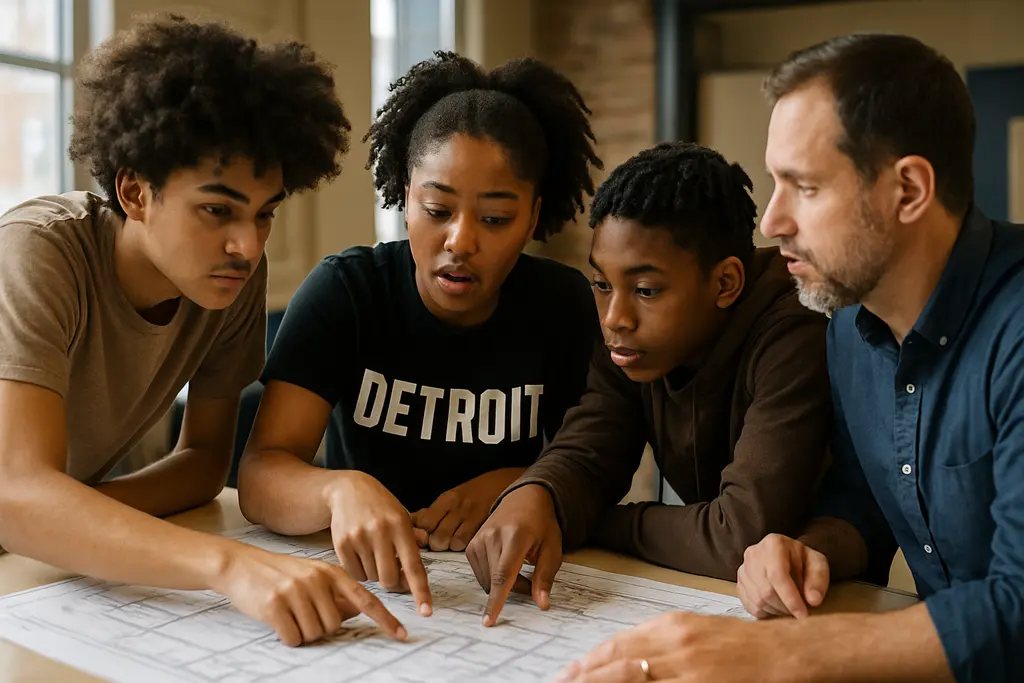
The Detroit youth design conversation moved from a general invitation to a documented part of city planning in 2026. By September 19, 2026, two public processes stood out for families, schools, churches, youth groups, and neighborhood organizations: the City of Detroit’s Rise Higher survey and Community Conversations, and the Downtown Detroit Partnership’s I-75 Cap Feasibility Study. Both efforts asked residents to help shape public priorities, and both offer lessons for how younger Detroiters can keep being heard after a meeting ends.
The most immediate change is that youth concerns were not treated as a side topic. In the Rise Higher process, the City of Detroit reported that more than 8,000 Detroiters responded to a citywide survey across all 39 zip codes, with nearly half of responses collected through door-to-door canvassing. The city also reported that more than 1,200 residents took part in five Community Conversations in March 2026, and that Youth & Education was one of six priority areas named by residents in the framework released on June 15, 2026, according to the city’s Rise Higher survey release.
Why Detroit Youth Design Input Changed Planning
Detroit Youth Design In The Citywide Survey
For community outreach workers, the value of the Rise Higher process is not only the number of survey responses. The city’s report said responses came from every Detroit zip code, and nearly half were gathered through door-to-door canvassing. That matters because families with limited time, transportation barriers, language needs, or low trust in formal meetings may still be reached when engagement comes to the block, the school, the recreation center, or the faith community.
The selection of Youth & Education as one of the six resident priority areas gives local groups a clear civic entry point. Youth-serving organizations can now connect their program ideas to a named city priority, rather than presenting youth needs as separate from housing, public safety, mobility, neighborhood services, or public space. That does not guarantee a specific policy result, but it does give residents a public record they can cite when asking for follow-up.
That follow-up should be specific. A youth council can ask how student safety, after-school access, arts spaces, and neighborhood routes are reflected in future city updates. A school partner can ask how families will be notified before the next round of input. A church youth ministry can help teens compare the city’s published themes with what they see on their own blocks. Those steps turn participation into civic learning.
What Community Conversations Added
The five March 2026 Community Conversations added a second layer to the survey work because the city said department heads were involved. For residents, that means comments were not limited to a suggestion box. They were part of a public engagement process where city departments could hear concerns across neighborhoods.
For young people, that format can be especially useful when adults prepare them before they enter the room. Youth participants often have direct knowledge of transit gaps, unsafe crossings, park conditions, school routes, recreation hours, lighting, and public spaces. A prepared youth group can arrive with photos, maps, written questions, and examples from daily life. That kind of preparation helps officials understand a concern as a design issue, not only a complaint.
How The I-75 Cap Study Used Public Input
Community Ideas Around The Cap Concept
The I-75 Cap Feasibility Study gave residents another way to think about design, access, and public space. The Downtown Detroit Partnership reported that, through the Vision & Alternatives Analysis phase in 2024 and 2025, more than 1,000 community members, including youth, helped select a preferred design concept for three park caps over I-75 between Brush Street and 3rd Avenue, according to the project’s I-75 Cap Feasibility Study.
As of September 19, 2026, the public meetings listed in the research for May 5, 2026, and July 30, 2026, had already taken place. Residents should not treat those sessions as future events. The practical step now is to review the public information released through the project, compare it with youth priorities, and prepare clear comments for any later official input opportunity that the project sponsor announces.
The importance of Detroit youth design work is easy to see in a project like this. A cap over a freeway is not only an engineering question. It raises everyday issues: who can reach the space, whether it feels welcoming to students, how programming works after school, whether crossings feel safe, and how nearby neighborhoods connect to the final plan. Young residents can speak directly to those daily patterns.
Lessons From Corridor Engagement
Detroit has seen youth engagement around other corridor and public-space planning conversations as well. Saint Joseph Detroit’s coverage of how youth shaped corridor plans is relevant because it shows the same civic lesson: young people need a way to move from listening sessions into documented recommendations, public follow-up, and continued accountability.
That lesson also applies beyond Detroit. Communities in other cities are asking how residents can compare notes on public participation, outreach, and neighborhood priorities. For readers tracking civic dialogue across local networks, the Houston LWS Forum provides a related site for community-centered public discussion.
Practical Steps For Youth And Adult Partners
Before The Next Input Session
Because the major sessions identified in the research have already occurred, the next useful action is preparation rather than promotion. Families, youth workers, and educators can help young residents organize their ideas before the next official meeting, survey, workshop, or public comment period is announced. Good preparation makes youth input easier for agencies to record and harder to overlook.
- Map daily routes: Ask students to mark where they walk, bike, take transit, wait for rides, or avoid unsafe crossings.
- Link ideas to public priorities: Connect comments to Youth & Education, public space, safety, access, or neighborhood services when those categories appear in official materials.
- Bring examples: Photos, written notes, and simple sketches can help explain what youth want changed.
- Ask for the record: Request where meeting notes, survey results, and next steps will be posted.
- Plan follow-up: Assign one adult and one youth participant to track updates after the session.
This is also where schools and nonprofits can support youth without speaking for them. Adults can explain the process, provide transportation, review public materials, and help young people prepare questions. The youth should still be able to name the issue, describe the lived experience, and ask for a response in their own words.
After Public Comment Ends
The period after a meeting can be just as important as the meeting itself. Outreach teams should save copies of agendas, surveys, presentation boards, and posted summaries. Youth groups can hold a short debrief within a week of a session and ask three questions: What did officials hear? What was missing? What follow-up is needed?
For Detroit youth design work to keep its value, residents need to track whether input shows up in later documents. If youth ask for safer crossings, public seating, youth programming, or clearer access routes, the next question is whether those ideas appear in project alternatives, department updates, budget requests, or public summaries. That record-based approach keeps the tone constructive while still asking for accountability.
What This Means For Community Outreach Teams

The Rise Higher process and I-75 Cap study point to a shared outreach lesson: young people should be invited early, given accessible ways to participate, and shown how their input is recorded. A survey can gather broad priorities. A public meeting can let residents test ideas in person. A youth activity station, mapping exercise, or school-based discussion can help younger residents explain what adults may miss.
Community groups can help by building a simple youth input calendar. The calendar should list official city surveys, school district meetings, planning workshops, transportation sessions, and public-space discussions when verified dates are available. It should also note whether the meeting has already happened, so families are not sent to outdated events. As of September 19, 2026, the May 5 and July 30 I-75 Cap meetings in the research were past events.
Outreach teams should also avoid treating youth participation as a one-day activity. A teen who attends a design meeting may need help reading the follow-up materials. A student who gives feedback on a park cap may want to know whether the final concept changed. A youth group that took part in a city survey may want to compare the final framework with what members said. These follow-up steps build civic confidence.
Detroit Youth Design Next Civic Steps
The civic task now is to keep Detroit youth design input connected to public records, not just public events. The City of Detroit has released survey findings and a resident-driven framework. The Downtown Detroit Partnership has documented public participation in the I-75 Cap Feasibility Study. Those records give families and youth-serving groups a starting point for the next round of questions.
Residents can ask agencies and project partners for plain-language updates, meeting summaries, and clear comment windows. Youth organizations can host preparation sessions before official meetings and debrief sessions afterward. Schools can help students practice reading project maps, survey summaries, and public notices. Churches and neighborhood groups can share verified dates once they are posted by the responsible agency.
Detroit youth design should be treated as a continuing civic practice. The goal is not only to place young people in a meeting room. The goal is to help them shape the record, understand the decision points, and see how public input connects to safer streets, stronger learning supports, more useful public spaces, and better neighborhood planning.