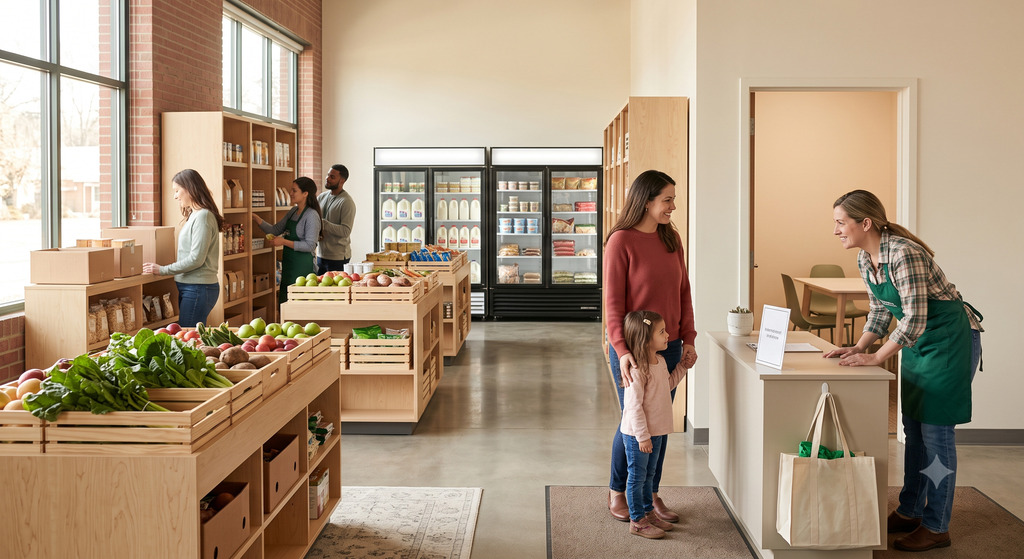
A $500,000 gift from Gordon and Holly Broom to Glen-Ed Pantry in Edwardsville, Illinois, is more than a large donation story. It shows how food aid programs can outgrow older buildings when demand rises, volunteer work becomes more complex, and families need private, respectful service spaces instead of crowded handoff lines. The gift supports Glen-Ed Pantry’s $3 million capital campaign for a new facility after the nonprofit broke ground on May 20, 2026, according to recent local reporting on the Glen-Ed Pantry capital campaign.
For Detroit churches, neighborhood groups, food pantries, and local aid programs, the Illinois example offers a useful planning question: what does a pantry need before the shelves are full? The answer includes cold storage, delivery access, client intake rooms, volunteer work areas, ADA-compliant entry, restrooms, meeting space, and enough room for families to receive help without feeling rushed or exposed.
Why The Illinois Gift Matters Beyond Edwardsville
Glen-Ed Pantry serves residents in Edwardsville Community Unit School District 7, including Edwardsville, Glen Carbon, Hamel, Worden, Midway, Moro, Dorsey, and Prairietown. Its capital campaign is focused on building a new home next to its current location at 125 Fifth Avenue in Edwardsville. Earlier reporting described the planned building as a roughly 9,000-square-foot facility designed to improve food storage, delivery flow, private client interviews, accessibility, thrift store operations, and expanded support services.
That matters because food assistance is often measured only by pounds of food distributed or the number of households served. Those numbers are important, but they do not tell the whole story. A pantry can have generous donors and committed volunteers while still struggling with cramped rooms, limited refrigeration, poor loading access, tight waiting areas, and no private place to speak with a family about bills, documents, or related needs.
Glen-Ed Pantry’s official capital campaign page says the organization has served the Edwardsville School District 7 area since 1980 and is raising funds for a new permanent home built by the community for the community. The campaign frames the new building as a long-term response to food insecurity, not just a construction project. The nonprofit’s new building campaign gives Detroit service groups a model for thinking about facility design as part of dignity-centered aid.
For Saint Joseph Detroit’s audience, the lesson connects directly with local conversations about Detroit food insecurity. Families need food, but they also need service systems that protect privacy, reduce confusion, and connect them to other supports when hunger is tied to rent, utilities, transportation, school supplies, or health needs.
What Dignity Looks Like Inside A Food Pantry

Dignity in a food pantry is not an abstract idea. It shows up in the layout. It shows up in whether a parent can ask for help without speaking across a crowded room. It shows up in whether older adults can enter safely, whether volunteers know where to direct people, and whether families can choose food that fits their household rather than receiving whatever happens to be easiest to move.
The Glen-Ed Pantry project highlights that point. Local coverage of the May groundbreaking described plans for a new facility with a commercial kitchen, client interview room, and expanded refrigeration capacity, along with space for pantry and thrift store operations. Those details point to a larger truth: food aid programs are often doing much more than giving out groceries.
A private interview room can help staff or volunteers talk with families about utility help, school supplies, holiday baskets, household needs, or other services. A commercial kitchen can support nutrition programming, food preparation, or community education. Expanded refrigeration can make fresh produce, dairy, proteins, and frozen foods easier to accept and distribute safely. Better delivery access can reduce volunteer strain and shorten the time between donation drop-off and family pickup.
Detroit groups can apply the same thinking without launching a $3 million campaign. A small pantry can review whether its waiting area protects privacy. A church food shelf can ask whether families have a clear sign-in process. A volunteer team can improve how shelves are labeled, how intake questions are asked, or how people are referred to other services. Dignity often starts with small operational choices before it becomes a building project.
Why Storage Capacity Is A Food Access Issue

Storage is one of the least visible parts of food assistance, but it can decide what kind of food families receive. A pantry with limited cold storage may be forced to turn down fresh produce, dairy, meat, prepared meals, or other perishable donations. A pantry with poor shelving may struggle to sort food by need, expiration date, household size, or dietary preference. A pantry with limited loading space may depend on volunteer labor that becomes harder to sustain over time.
Detroit’s food system already shows how much infrastructure matters. Forgotten Harvest says it delivers 144,000 pounds of surplus food per day to local charities five days a week, providing fresh and nutritious food free of charge to families in need. Its distribution model depends on rescue, transportation, partner agencies, and pantry capacity, not just donor generosity. The organization’s Metro Detroit food rescue work shows why storage and logistics are central to hunger relief.
The same issue appears in smaller neighborhood settings. If a pantry receives a large donation but lacks freezer space, shelf space, or volunteer sorting capacity, the gift may not reach families in the most useful form. If fresh food arrives without enough refrigeration, staff may have to distribute it immediately or decline future donations. If volunteers have no staging area, food lines become slower and more stressful.
| Facility Need | Why It Matters | Local Aid Program Question |
|---|---|---|
| Cold Storage | Allows pantries to accept fresh, frozen, and perishable food | Can the pantry safely store produce, dairy, meat, and prepared food? |
| Delivery Access | Reduces delays and volunteer strain during drop-offs | Can trucks unload without blocking family service areas? |
| Private Intake Space | Protects dignity during sensitive conversations | Can families discuss needs without speaking in public? |
| Volunteer Work Area | Makes sorting, packing, and training more efficient | Do volunteers have enough room to work safely? |
| Accessible Entry | Helps older adults, disabled residents, and caregivers | Can residents enter without barriers or confusion? |
Detroit pantries and aid groups do not need to wait for a major building project to use this framework. A yearly facility review can identify whether the most urgent need is a refrigerator, shelving, signage, privacy screen, safer entrance, better volunteer schedule, or stronger referral process.
How Detroit’s Pantry Network Shows The Same Pressure
Detroit’s own pantry network has faced periods when food access needs became urgent enough to require citywide coordination. In November 2025, the City of Detroit launched an interactive food pantry map during SNAP-related uncertainty, listing 85 verified pantry locations at launch and expecting the list to reach 100 shortly after. The city said residents could use the map to find nearby pantry names, addresses, phone numbers, and operating hours through the official Detroit food pantry map.
That kind of map is a public-service tool, but it also reveals the operational challenge behind the scenes. When residents are directed to dozens of pantry locations, each site needs enough space, volunteers, storage, and accurate hours to handle demand. A pantry map helps people find food; local pantry infrastructure decides whether the visit feels organized, respectful, and useful.
Detroit also has large, established service providers carrying heavy food-support loads. Capuchin Soup Kitchen reports that in 2024, it supplied nearly 3.4 million pounds of food through its food pantry and served 236,787 meals, about 1,000 per day, through its soup kitchens. Those numbers from Capuchin Soup Kitchen show how food assistance relies on both large-scale operations and neighborhood-level trust.
For smaller churches and community groups, the Glen-Ed Pantry example should not feel out of reach. The central lesson is not that every local aid program needs a new building. The lesson is that space planning is mission planning. A cramped room can limit dignity. A missing freezer can limit nutrition. A weak volunteer flow can limit how many families receive support. A lack of private conversation space can prevent families from asking about deeper needs.
Why Volunteer Space Shapes The Quality Of Help
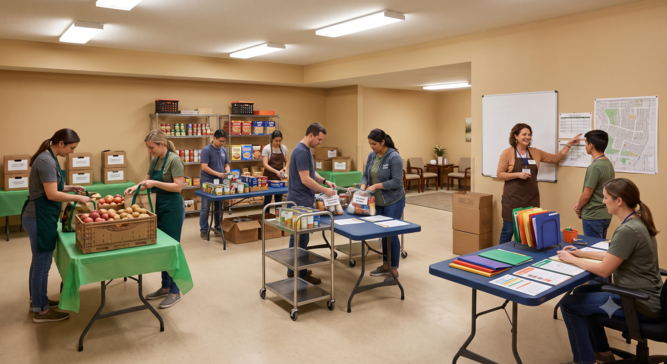
Food pantry volunteers need more than goodwill. They need space to sort, pack, greet, guide, carry, clean, document, and refer. When volunteer space is poorly designed, the work becomes harder and mistakes become more likely. Boxes pile up in hallways. Intake tables crowd family areas. New volunteers receive rushed instructions. Donations become harder to track.
Glen-Ed Pantry’s planned expansion speaks to that problem. The new facility is expected to provide more room for clients, volunteers, and staff, with improved storage and distribution capacity. That design choice matters because volunteers are part of the service experience. A calm, trained volunteer can make a family feel welcome. A crowded, confused workflow can make the same family feel like a burden.
Detroit groups can strengthen volunteer space even in older buildings. A simple floor plan can separate donation intake from family pickup. Color-coded shelves can reduce sorting time. A short volunteer orientation can explain respectful language, privacy, and referral boundaries. A clear shift schedule can prevent overcrowding at one hour and understaffing at another.
The City of Detroit’s food pantry response also showed the importance of people power. When the pantry map launched, the city said more than 860 Detroiters had volunteered to work food pantry shifts beginning the next day. That response shows that residents want to help, but local aid programs need systems ready to receive that help. Volunteers are most effective when they have assigned roles, safe work areas, and a clear point of contact.
What Detroit Aid Programs Can Learn From The $500,000 Gift
The $500,000 gift to Glen-Ed Pantry should be read as a facilities lesson for the wider charitable food system. Money for buildings, shelving, refrigerators, restrooms, accessible entry, interview space, and volunteer rooms may not sound as urgent as food itself, but those investments shape whether food reaches families with care.
Detroit aid programs can use the Illinois example to ask practical questions before launching the next food drive or donation campaign:
- Is our biggest need food, cold storage, shelving, transportation, volunteers, privacy, or intake support?
- Can families receive help without being exposed to unnecessary embarrassment?
- Do volunteers know how to sort, greet, refer, and protect privacy?
- Can we accept fresh food safely, or are we limited to shelf-stable items?
- Are our hours, location, and referral process easy for residents to understand?
Those questions turn a donation story into a local planning tool. A $500,000 gift may be rare, but the reasoning behind it is useful for every pantry. Glen-Ed Pantry is investing in a building because its service model requires room for dignity, storage, and people. Detroit programs can use the same logic at smaller scales, from a better refrigerator to a better intake table.
Why Food Aid Planning Should Start Before Demand Spikes
Food insecurity often becomes most visible during emergencies, benefit disruptions, school breaks, job losses, heat waves, and holiday seasons. By that point, pantries are already under pressure. The Illinois campaign shows why the strongest local aid programs plan before the surge.
For Detroit, that means churches, nonprofits, community centers, and volunteer groups should review food-service capacity before the next crisis. The review should include what families experience when they arrive, how volunteers move through the space, whether fresh food can be stored, whether private conversations can happen, and whether residents leave with clear next steps.
The Glen-Ed Pantry gift is a reminder that hunger relief is not only about generosity. It is about infrastructure. It is about whether a family can ask for help with dignity. It is about whether volunteers have enough room to work safely. It is about whether fresh food can be stored long enough to reach the right household. It is about whether a local aid program can keep serving when demand grows.
Detroit does not need to wait for a headline-making donation to act on those lessons. Every pantry, church, and neighborhood aid group can begin with one question: what part of our space makes help easier, and what part makes help harder? The answer can shape the next fundraiser, the next volunteer training, and the next improvement that turns local compassion into reliable support.