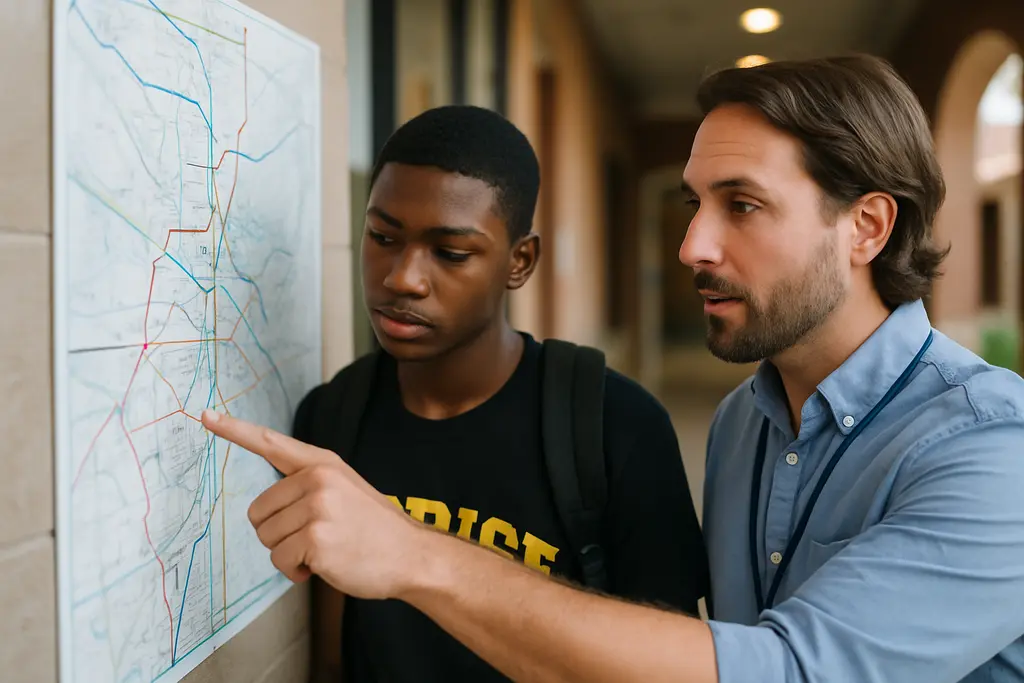
The Ride to Rise conversation remains a practical education issue for K-12 families, schools, churches, and youth-serving groups working to keep students connected to class, tutoring, meals, after-school programs, and safe routes home. National school transportation data shows why local planning matters: in April 2025 data collected through the National Center for Education Statistics, 87% of public schools reported that school buses were available to take students to and from school, while only 40% of public-school students traveled by bus on a typical day, and 51% of public schools said distance from home to school was a barrier to walking, biking, or using public transit for commuting, according to the NCES School Pulse Panel.
The sources provided for this article do not include a fresh, district-level 2026 count for Detroit student riders, so this report stays with verified national data and previously published local program context. For readers following the Detroit DDOT access issue, our prior Ride to Rise student transit coverage described the local student transit readiness work connected to K-12 bus access and family planning. The local civic question is direct: how can schools and community partners make transportation easier to understand, easier to verify, and less likely to interrupt attendance?
Why Ride to Rise Still Matters for Attendance
Ride to Rise and Attendance Barriers
Transportation is not only a morning routine. It is an attendance support, a family work-schedule issue, a safety-planning issue, and a youth-program access issue. If a student misses a ride, cannot afford a trip, lacks a clear route, or has no adult available to confirm options, the school day can be disrupted before the first class begins. That pressure is felt most by students whose families have fewer backup options.
The 2025 State of School Transportation Report, based on the AP-NORC School Transportation Administrator Survey conducted in June and July 2025, reported that 45% of U.S. public school districts said all students qualify for free, school-provided transportation. The same report found that administrators identified certain groups as qualifying for free rides at different rates, including students with disabilities at 33%, students experiencing homelessness at 29%, students from low-income families at 22%, students living far from school at 22%, students in foster care at 20%, and chronically absent students at 5%, according to the 2025 transportation report.
What The National Data Shows
The same 2025 report said 44% of districts saw increases over the prior five years in the number of students qualifying for free transportation, while 46% saw no change and 8% saw decreases. For the next five years, 45% expected eligibility to grow, 43% expected it to remain stable, and 8% expected it to drop. Those figures point to a steady service-planning concern rather than a short-term inconvenience.
The report also found that 75% of school administrators said access to school-provided transportation affects chronic absenteeism in their schools or districts. That does not mean transportation is the only attendance issue. It does mean any serious attendance plan should ask whether families know their options, whether students can get to school consistently, and whether support teams notice transportation problems early enough to respond.
Which Students Need The Clearest Transportation Path
Eligibility Is Not The Same Everywhere
Free transportation rules are not uniform across every school system. Some students qualify by grade level, disability status, housing status, foster-care status, distance from school, or local policy. Other students may live close enough to school that bus service is not provided, even when the route is hard for a young child or difficult during bad weather. The verified national sources show broad differences in access; they do not provide one rule that applies to every community.
That is why local schools, faith communities, and family support workers should treat transportation guidance as a year-round communication task. Families need plain answers: who qualifies, what identification is needed, where students board, what to do if a pass is lost, how early students should arrive, and who to contact if a route or schedule creates a barrier. A student who technically has access can still miss school if the process is confusing.
Faith And School Partners Can Reduce Daily Friction
A Ride to Rise approach should focus on the everyday points where families get stuck. Churches, schools, and youth programs can help by hosting route-planning sessions, printing one-page transit reminders, setting up school-year check-ins, and connecting families with school offices before an attendance problem grows. These steps do not replace school district transportation departments or public transit agencies. They help families use the services that already exist.
For those interested in broader civic engagement at the county level, County Watchers offers insights and updates on public issues, acting as a related site within this network.
Practical Steps For Schools, Churches, And Families

Make The Morning Trip Easier To Verify
The most useful transportation support is often simple. A family may need a written plan on the refrigerator, a backup adult contact, a reminder of the bus stop location, or a phone number for the school office. A student may need help practicing a route, understanding transfer points, or knowing what to do if a bus is missed. Schools and community partners can make these details part of back-to-school events, parent meetings, tutoring intake, and youth ministry check-ins.
- Confirm eligibility early: Families should ask the school or district which students qualify for free transportation and what documentation is required.
- Write down the daily route: Include pickup location, expected arrival time, return plan, and an emergency contact.
- Plan for after-school changes: Tutoring, athletics, clubs, and faith-based programs may end after the normal school-day trip.
- Watch for attendance signals: Repeated tardiness or absences can be a sign that a transportation plan is not working.
- Use verified updates: Families should rely on school, district, or transit communications for route changes and service notices.
Use Transportation As A Student Support Signal
For families, missing transportation can feel like a private problem. For schools and outreach teams, it should be a support signal. If a student is absent on rainy days, late after a housing move, or unable to stay for tutoring because of the trip home, staff and volunteers can ask practical questions without blame. Is the route clear? Is the cost an issue? Does the student need a safer pickup plan? Does the family know who to call?
Faith communities can be especially helpful because they often see families outside the school building. A parish, church, or neighborhood ministry may learn that a student is having trouble getting to class, reaching a meal program, or staying after school. The best response is to connect the family with verified school or transit information, not to rely on informal guesses.
Ride to Rise Student Access Priorities
For Ride to Rise to remain useful during the school year, the priority should be clear communication, early problem-solving, and shared responsibility among families, schools, transit contacts, and community partners. National data confirms that bus availability and actual student use are not the same thing. It also shows that administrators see transportation as connected to chronic absenteeism.
Local education and faith partners can respond by keeping transportation questions visible: ask about the trip to school during student intake, include transportation reminders in family newsletters, help parents verify eligibility, and treat late arrivals as a chance to solve a barrier rather than assign fault. Free transportation access matters most when students and families understand how to use it every school day.
The work is not only about getting a student onto a bus. It is about protecting attendance, widening access to learning support, and helping families build a reliable school-year routine. That is a practical civic goal, and it belongs in every serious conversation about K-12 student success.