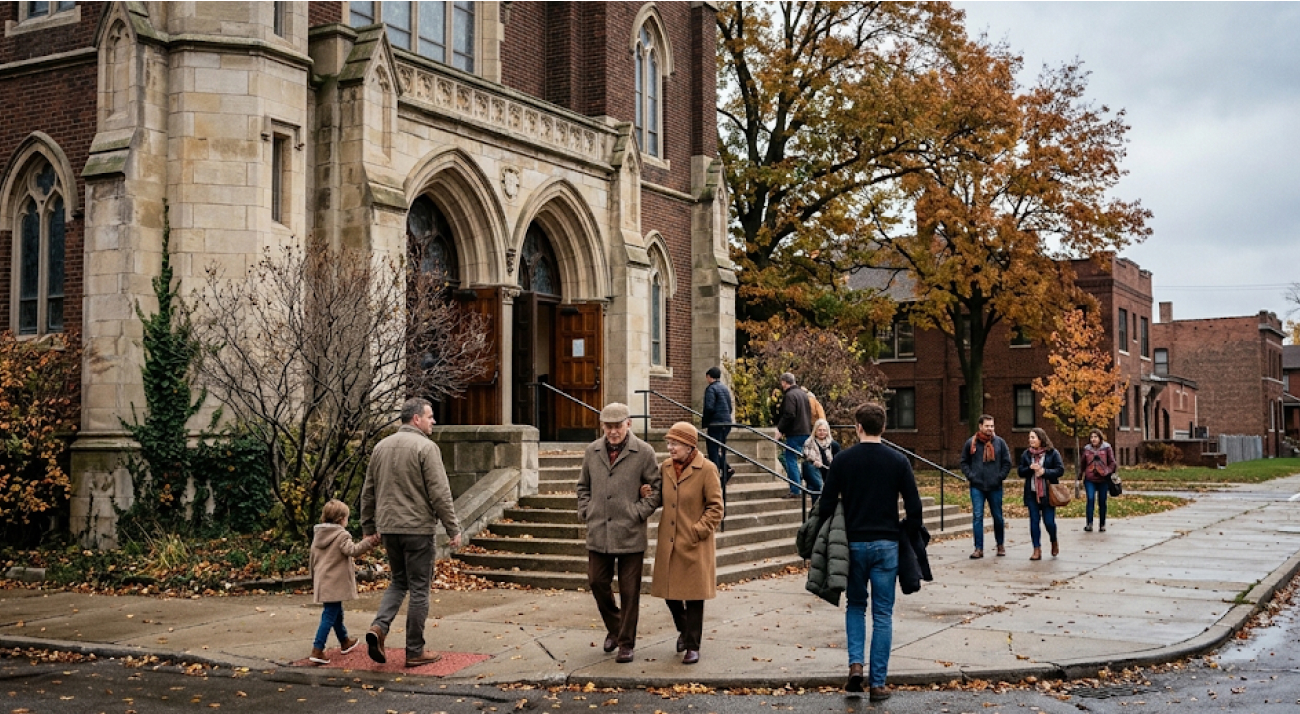
The Archdiocese of Detroit has released a second round of draft pastorate models after thousands of Catholics shared their concerns and hopes for the future. Here is what the revised plans could mean for parish communities, weekend Masses, priests, and the future of Catholic life across southeast Michigan.
For generations, Catholic parishes across Detroit and southeast Michigan have served as places of worship, family celebrations, religious education, and community support. Baptisms, weddings, funerals, and Sunday Mass have helped shape the identity of neighborhoods and families throughout the region.
Now, many of those communities are preparing for significant changes.
On October 19, 2026, the Archdiocese of Detroit released a second round of draft pastorate models as part of its ongoing effort to reorganize parish life. The revised proposals followed months of feedback from parishioners, priests, and parish leaders, with the goal of creating a more sustainable structure for Catholic ministry.
The process is being led by Archbishop Edward J. Weisenburger and addresses several challenges facing the local Church: fewer priests available for parish ministry, declining Mass attendance, reduced participation in the sacraments, and the difficulty of maintaining buildings and ministries designed for a larger Catholic population.
The decisions ahead could reshape how parishes cooperate, where weekend Masses are celebrated, and how priests and parish leaders organize their work. However, the archdiocese has emphasized that the newly released models are still proposals, not final decisions.
For Catholics throughout Detroit, the months ahead will be an important period of discernment, preparation, and continued engagement with the future of their communities.
Why Is the Archdiocese of Detroit Restructuring Its Parishes?
The restructuring initiative responds to long-term changes in Catholic life across southeast Michigan.
According to the archdiocese’s official restructuring website, the local Church once served approximately 1.5 million Catholics and now ministers to around 900,000. Fewer than half attend Mass regularly, while the number of available priests has continued to decline.
These changes affect more than attendance figures. Parish communities must maintain buildings, organize religious education, celebrate the sacraments, support charitable ministries, and manage administrative responsibilities with fewer clergy and, in some cases, fewer active parishioners.
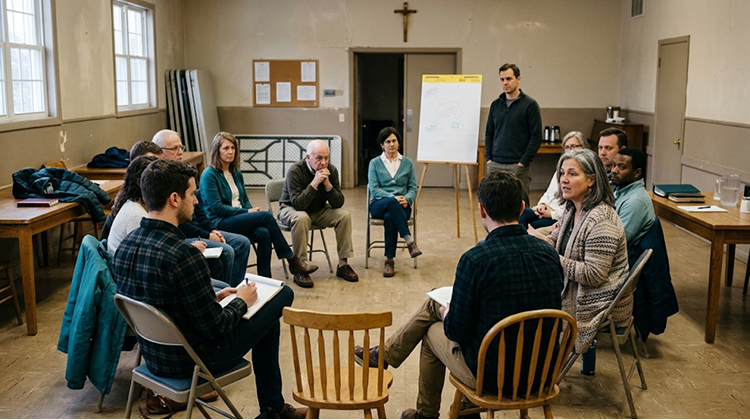
The archdiocese has also warned that the shortage of priests will remain a serious concern. Its restructuring FAQ projects that by 2029, fewer than 165 priests will be serving in parish ministry.
The result is a growing imbalance between the number of parish communities requiring pastoral leadership and the number of priests available to serve them.
Rather than treating each parish as an entirely separate operation, the archdiocese is considering new groupings that could allow clergy and parish leaders to coordinate their responsibilities more effectively.
The initiative is organized around three stated goals:
- Vibrant parishes: Communities where Catholics can encounter Christ, grow in faith, and build lasting relationships.
- Flourishing priests: More sustainable workloads that allow priests to focus on pastoral ministry rather than being overwhelmed by administration.
- A mission-ready Church: Parishes equipped to evangelize, serve their neighbors, and sustain Catholic life into the future.
The challenge is to pursue those goals while respecting the histories, traditions, and relationships that make each parish meaningful to its members.
What Are Pastorates, and How Would They Change Parish Life?
A central part of the restructuring proposal is the creation of pastorates.
A pastorate is a grouping of one or more parishes led by a single pastor and leadership team. Under the proposed approach, communities could share pastoral leadership and coordinate ministries while retaining their individual parish identities unless a separate merger is formally undertaken.
This distinction is important. Joining a pastorate does not automatically mean that every parish will become one parish or that its buildings will close.
The archdiocese’s FAQs state that parishes grouped into a pastorate generally retain their own canonical identity and financial accounts unless they merge. Funds collected locally would continue to support the communities from which they were given, and parishes would not automatically assume one another’s debts simply because they share a pastorate.
In practical terms, a pastorate could coordinate Mass schedules, sacramental preparation, religious education, staff responsibilities, and other ministries across several communities.
The intended benefit is greater unity in pastoral planning and less duplication of administrative work. A shared leadership structure could give priests more time for celebrating the sacraments, visiting parishioners, accompanying families, and supporting people in need.
However, the actual experience will depend on the final model adopted for each area. Parishioners will need clear information about schedules, leadership, ministry coordination, and the future responsibilities of individual church communities.
More Than 40,000 Parishioners Helped Shape the Revised Plans
One of the most significant elements of the restructuring process has been the opportunity for Catholics to provide feedback.
Between April and July 2026, more than 40,000 parishioners attended 412 listening sessions, while approximately 17,000 people completed an online survey about the initial draft models. The archdiocese also received thousands of emails, phone calls, and other comments.
The listening sessions gave parishioners opportunities to share concerns about proposed parish groupings, weekend Mass schedules, travel between churches, and the future of their local communities.
The feedback was reviewed during the summer and early fall, helping inform a revised set of proposals.
In September, representatives from the archdiocese’s 15 planning areas met to refine the original models. The second round, released October 19, contains two proposed models for each of the 15 planning areas, compared with three or four options in the first round. The revised materials also explain changes made in response to the feedback.
Some proposals have been substantially revised, some are entirely new, and others remain largely unchanged.
For Archbishop Weisenburger, the process involves recognizing the personal significance of the communities affected. In his October update, he acknowledged that parishes are deeply loved and often feel like members of the family because they have accompanied people through important moments of life.
That recognition is especially important when a proposed change affects a church where generations have been baptized, married, buried, and formed in the faith.
What the Second Round Means for Weekend Masses
For many Catholics, the most immediate concern is whether their church will continue celebrating weekend Mass.
The revised models still include locations identified as having “no weekend Masses.” Archbishop Weisenburger clarified that these locations would be combined with another parish, or with other parishes in the pastorate, to form a single, unified parish community.
This is a consequential distinction. The proposed end of weekend Mass at a particular building does not necessarily mean the building will immediately close, nor does it automatically establish that the parish itself will cease to exist. The precise implications depend on the final decisions and subsequent planning.
The revised models also show that the proposals remain open to change. Some churches that were not proposed to lose weekend Masses in the first round appear in the second round as locations where weekend Masses could stop under at least one option. Other communities have seen their prospects improve.
Examples identified in recent reporting include:
- St. Moses the Black Parish in Detroit: A location that now retains weekend Masses under the revised proposals where earlier options had suggested otherwise.
- Most Holy Trinity Parish in Detroit’s Corktown neighborhood: Another community where the revised models preserve weekend Masses under options that had previously proposed otherwise.
- St. Aloysius Parish in Detroit: A community that appears in the second-round proposals as a location where weekend Masses could be discontinued under at least one model.
- Sacred Heart Parish in Grosse Ile: Another location affected by the revised weekend-Mass proposals.
These examples illustrate why parishioners should review the second-round models rather than relying exclusively on information from the first phase.
They are not final announcements about the future of these churches. The archdiocese has stressed that the draft models remain subject to review and discernment.
For families, older parishioners, and people who depend on a nearby church, the eventual Mass schedule will be particularly important. Travel distances, accessibility, transportation, and the coordination of sacramental celebrations will all influence how changes are experienced locally.
How the Restructuring Could Affect Priests and Parish Leaders
The restructuring process is not only about church buildings or Mass schedules. It is also intended to address the demands placed on priests and parish staff.
Under existing arrangements, priests may carry significant responsibilities across several communities, including sacramental ministry, administration, staff supervision, financial oversight, and pastoral care.
The proposed pastorate model seeks to establish a more unified leadership structure. By streamlining some administrative duties, the archdiocese hopes to give priests more time for direct pastoral work and evangelization.
Priest assignments will therefore be an important part of the next stage of the process.
According to the archdiocese’s published timeline, final pastorate decisions and associated priest assignments are expected to be announced in April 2027. The specific assignment process will consider each priest individually.
For parishioners, changes in priest assignments can be deeply personal. Priests often accompany families through baptisms, weddings, funerals, illness, and other defining moments. A new assignment can therefore represent a significant transition even when the wider parish community continues.
The archdiocese’s stated objective is to create a structure in which priests can serve more sustainably and communities can maintain a strong pastoral presence.
Whether the model achieves that objective will depend on how responsibilities are distributed, how well parish leadership teams work together, and how effectively the needs of individual communities are addressed.
What Happens to Parish Schools, Cemeteries, and Finances?
Questions about the future of parish schools, cemeteries, and financial resources are understandable because these institutions often play a central role in community life.
The archdiocese’s official FAQs clarify that all parishes are included in the restructuring process, including those with schools and cemeteries. Having a school or cemetery does not exempt a parish from consideration.
That does not mean every school will close or that every cemetery will undergo a change in operations. The final implications will depend on the approved pastorate arrangements and any subsequent decisions.
Financially, the archdiocese says that parishes grouped into a pastorate will generally retain their own accounts and canonical identities unless a merger occurs. Offerings and other collected funds will continue to support the communities from which they originate, while detailed financial planning will form part of the implementation process.
This distinction is important for donors and parishioners who want to understand how their contributions will be used.
For communities with schools, the process may raise questions about leadership, shared services, religious education, and coordination between parish and school ministries. For parishes with cemeteries, pastoral care for grieving families and the ongoing responsibilities of cemetery operations will also require attention.
The official restructuring materials provide the broad principles, but families should seek clarification from their parish leaders about any proposed changes specific to their community.
When Will Final Decisions Be Announced?
As of October 22, 2026, the archdiocese remains in the listening-and-refinement phase. The second round of draft models has been published, but the process is not complete.
The official timeline sets out the following milestones:
October 19, 2026 — Second-round draft models released
Revised proposals for all 15 planning areas became available for review.
Fall 2026 — Further review and discernment
Priests, key parish leaders, the Archdiocesan Restructuring Commission, and other consultative groups review the revised proposals. Parishioners can continue providing feedback through their parish leaders.
April 17–18, 2027 — Final decisions expected
The archdiocese expects to share the approved pastorate models and priest assignments with parishes and publish them online.
July 1, 2027 — Implementation begins
The new pastorate groupings and priest assignments are scheduled to take effect.
Source: Official Archdiocese of Detroit restructuring timeline.
The archdiocese has emphasized that the process is intended to include discernment and consultation rather than simply implementing a predetermined set of closures. Parishioners can review the models and follow developments through the official restructuring website.
How Parishioners Can Stay Informed and Participate
Although the broad public feedback survey has closed, the second-round proposals are still part of an ongoing review process. Parishioners can continue to raise questions and share relevant information through their parish leaders.
There are several practical steps Catholics can take:
- Review the model for your planning area. Read the actual proposal rather than relying on summaries or social media discussions.
- Speak with your pastor or parish leadership team. Ask how the options could affect Mass schedules, sacramental preparation, religious education, schools, cemeteries, and community ministries.
- Share specific concerns through parish leaders. The archdiocese says additional feedback can still be communicated through local leadership.
- Follow official announcements. Use the Archdiocese of Detroit’s restructuring website for updated models, FAQs, and timeline information.
- Pray for the communities affected. The process involves practical decisions, but it also carries spiritual and emotional significance for many families.
Constructive engagement will be particularly important as the final proposals are refined. Local parishioners often understand details about their communities that may not be fully reflected in administrative data alone, including the needs of older adults, families with young children, and people who rely on parish ministries for support.
Preserving Catholic Community While Preparing for the Future
Detroit’s parish restructuring raises difficult questions because churches are more than buildings. They are places where people encounter Christ, celebrate the sacraments, form friendships, teach children the faith, and accompany one another through life’s most important moments.
The archdiocese faces real pressures from changing participation, fewer available priests, and the financial and practical demands of maintaining a large network of parishes. Its proposed pastorate model is an effort to respond to those challenges while sustaining Catholic ministry across southeast Michigan.
The second-round drafts show that parishioner feedback has been part of the process, but they also demonstrate that difficult decisions remain ahead. Some communities may experience changes to weekend Mass schedules, shared leadership, or parish organization. Others may see revised proposals that preserve more of their existing arrangements.
For Saint Joseph Detroit and the wider Catholic community, the central question is how restructuring can protect the heart of parish life while making ministry more sustainable for the next generation.
The final outcome will depend not only on the models approved in 2027, but also on how clergy, parish leaders, and parishioners work together afterward. Transparent communication, practical pastoral planning, and a continued commitment to worship and service will be essential.
The process is not yet finished. For now, Catholics across Detroit and southeast Michigan have an opportunity to remain informed, share their concerns, and help their communities prepare for the next chapter of local Church life.