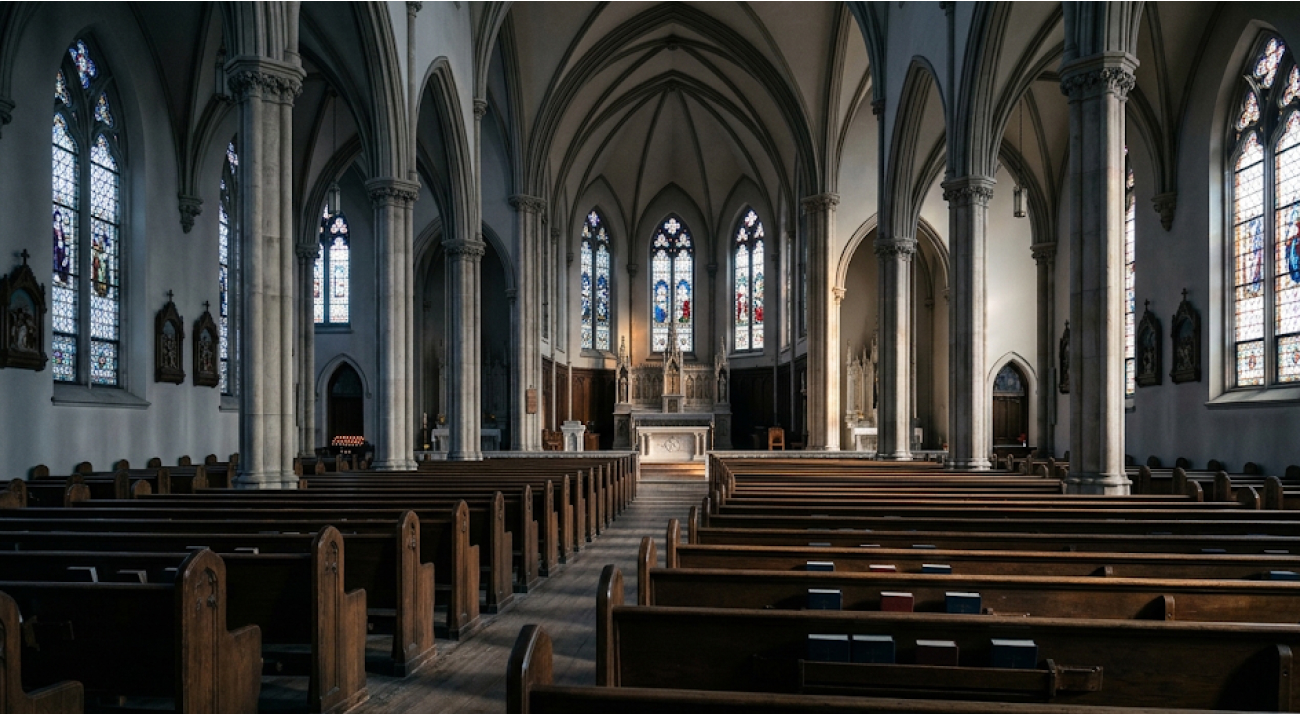
New parish restructuring proposals could eliminate regular Saturday evening and Sunday Masses at as many as 20 Catholic churches within Detroit’s city limits. As the Archdiocese of Detroit prepares for major changes in 2027, parishioners face difficult questions about historic churches, priest shortages, and the future of neighborhood Catholic communities.
DETROIT, Michigan — November 10, 2026. The Archdiocese of Detroit is considering sweeping changes to its parish network that could leave approximately half of the Catholic churches within Detroit’s city limits without regularly scheduled weekend Masses.
According to a November 7 report by The Detroit News, 16 of Detroit’s approximately 39 Catholic churches would lose Saturday vigil and Sunday Masses under both restructuring models being considered. Four additional churches could lose weekend Masses under one of the proposed models.
That means as many as 20 churches, or approximately 51% of the city’s Catholic churches, could be affected in the more extensive scenario.
The proposals are part of a broader archdiocesan effort to address declining participation, a shrinking number of priests, aging church buildings, and financial pressures affecting Catholic communities across southeast Michigan.
However, the figures describe proposed changes, not confirmed closures or final Mass schedules. Archbishop Edward J. Weisenburger has emphasized that the restructuring process remains under review, with final decisions expected in April 2027.
The potential changes have raised important questions about how Catholics will access Sunday Mass, what will happen to historic parish buildings, and how the Church can preserve community relationships while adapting to changing circumstances.
For many Detroit Catholics, a parish is more than a place to attend Mass. It is where generations of families have celebrated baptisms, weddings, funerals, religious education, and community traditions.
The restructuring process therefore represents one of the most consequential periods of transition for the local Church in recent decades.
What Do Detroit’s New Catholic Restructuring Proposals Show?
The latest analysis of the archdiocese’s planning models suggests that Detroit could experience a substantial reduction in the number of churches offering regular weekend Masses.
The November 7 report examined two restructuring scenarios and their potential consequences for churches within the city.
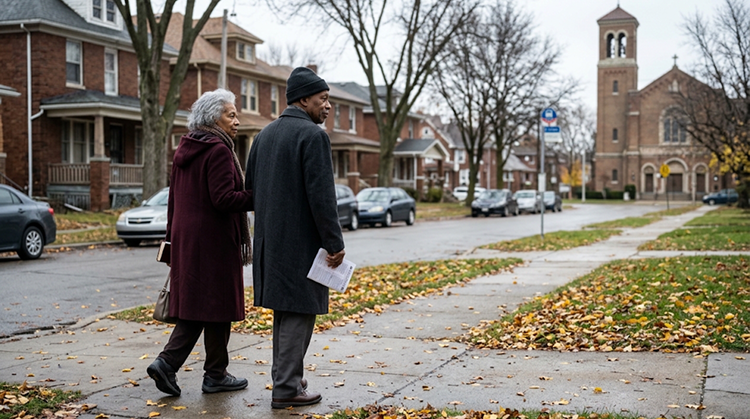
Both models would remove regularly scheduled weekend Masses from 16 churches. One scenario could affect four additional locations.
DETROIT CATHOLIC RESTRUCTURING — KEY FIGURES
39
Approximate number of Catholic churches in Detroit
16
Churches losing weekend Masses under both models
20
Maximum potentially affected in one model
April 2027
Expected announcement of final decisions
Figures are based on the November 7, 2026, reporting and represent proposed scenarios, not final decisions.
How many churches could be affected?
| Proposed outcome | Churches | Share of Detroit’s 39 churches |
|---|---|---|
| Lose weekend Masses under both models | 16 | 41.0% |
| Additional churches affected under one model | 4 | 10.3% |
| Maximum potentially affected | 20 | 51.3% |
| Not affected in the broader scenario | 19 | 48.7% |
The figures illustrate why the proposals have attracted significant attention.
A reduction of this scale could change where thousands of Catholics attend weekend worship and how neighborhood parishes organize their ministries.
Yet the outcome will depend on decisions that have not been finalized.
Losing weekend Mass does not necessarily mean a church will close
One of the most important distinctions in the restructuring process concerns the difference between a church losing its regular weekend Mass schedule and a church building closing permanently.
A parish church might no longer host Saturday vigil or Sunday Mass while continuing to be used for other purposes.
Depending on final decisions, a building could potentially remain available for weekday liturgies, funerals, devotions, special celebrations, or other approved religious activities.
Alternatively, a parish merger might eventually lead to the closure of a building.
These are different outcomes that require separate administrative, pastoral, and sometimes canonical decisions.
The proposed elimination of weekend Masses at a church should not be reported as confirmation that the church will be permanently closed or demolished.
Why Is the Archdiocese of Detroit Restructuring Its Parishes?
The restructuring initiative is intended to address several pressures that have accumulated over decades.
The Archdiocese of Detroit once served approximately 1.5 million Catholics. Today, it estimates that its Catholic population is approximately 900,000.
At the same time, Mass attendance, participation in the sacraments, and the number of priests available for active ministry have declined.
The archdiocese says it must reorganize its resources so that parishes can continue offering worship, religious education, charitable assistance, and community services in a sustainable way.
1. Declining Catholic Mass attendance
Since 2011, Mass attendance across the archdiocese has declined by approximately 40%.
This decline has created a growing difference between the number of worshippers attending Mass and the capacity of existing church buildings.
In Detroit specifically, Father Mario Amore, the archdiocese’s executive director of parish renewal, provided figures that illustrate the imbalance.
Detroit Catholic church seating capacity versus weekend attendance
09,00018,00027,00036,000Total seating capacityWeekend Mass attendance
Approximate figures reported by Father Mario Amore in November 2026.
Combined seating capacity is nearly 34,000, compared with approximately 14,361 weekend Mass attendees. These figures are not a measure of attendance at every individual Mass. AOL
The figures suggest that approximately 42% of the combined seating capacity would be occupied if all weekend attendees were distributed across one Mass at each church.
That comparison does not mean every church is equally underused. Some parishes have well-attended liturgies, while others serve much smaller congregations.
Nevertheless, the overall numbers help explain why archdiocesan leaders believe that the current network of buildings is larger than the active worshipping population requires.
2. A projected shortage of priests
The archdiocese also faces a declining number of priests available to celebrate Mass, administer the sacraments, and lead parish communities.
According to October 20 reporting by CBS Detroit, the archdiocese anticipates having approximately 90 fewer priests over the next decade.
Priests are responsible for more than celebrating weekend liturgies. Their duties also include funerals, weddings, confessions, hospital visits, spiritual counseling, parish administration, and other ministries.
When fewer priests are available, maintaining multiple weekend Mass schedules across numerous buildings becomes increasingly difficult.
The archdiocese has identified healthy and sustainable priestly ministry as one of the central goals of its restructuring initiative.
3. Aging buildings and expensive maintenance
Detroit’s Catholic churches include some of the city’s most historically significant religious buildings.
Many were constructed during periods when Detroit had a substantially larger Catholic population.
As congregations have changed, these buildings have continued to require repairs and ongoing maintenance.
According to Father Amore, Catholic churches within Detroit collectively face approximately $23.5 million in unfunded deferred maintenance. AOL
Across the broader archdiocese, earlier reporting identified approximately $94 million in unfunded building repairs. Axios Detroit
These are different geographic totals: the $23.5 million figure refers to Detroit churches, while the larger figure covers the archdiocese more broadly.
Repairs may involve roofs, heating systems, masonry, electrical infrastructure, and accessibility improvements.
For parishes with declining attendance or limited financial reserves, maintaining aging facilities can place considerable pressure on their ability to fund religious and charitable programs.
Which Detroit Catholic Churches Could Lose Weekend Masses?
The proposed changes affect churches in different parts of the city, including downtown Detroit, the east side, the west side, and southwest Detroit.
Some of the affected churches have served specific immigrant communities for generations. Others are important institutions in predominantly African American or Hispanic neighborhoods.
The following examples were identified in the November 7 reporting by The Detroit News. They are not a complete list of the 20 potentially affected locations. AOL
| Church | Location | Status in draft models |
|---|---|---|
| Holy Cross Hungarian Catholic Church | Delray, southwest Detroit | No weekend Mass under both models |
| St. Francis D’Assisi Church | Southwest Detroit | No weekend Mass under both models |
| St. Augustine–St. Monica Parish | Detroit’s east side | No weekend Mass under both models |
| St. Hyacinth Church | Detroit | No weekend Mass under both models |
| St. Juan Diego Parish | Detroit’s west side | No weekend Mass under both models |
| St. Clare of Montefalco Church | Grosse Pointe Park | No weekend Mass under one model |
St. Clare of Montefalco is outside Detroit’s city limits and is included here because of its importance to the neighboring east-side Catholic community. It should not be counted among the 39 churches located within Detroit.
Holy Cross: Preserving Detroit’s Hungarian Catholic heritage
Holy Cross Hungarian Roman Catholic Church History | 8423 South Street | Detroit, Michigan — EHERG
Holy Cross Hungarian Catholic Church, located on South Street in Detroit’s Delray neighborhood, is an important symbol of the city’s Hungarian Catholic heritage.
The parish’s roots extend to the early twentieth century, and its current church building opened in 1925.
The church offers worship in both English and Hungarian, helping preserve a religious and cultural tradition that has endured through generations.
Shirley Kovacs, a lifelong parishioner, expressed concern about the possibility of losing regular weekend Masses.
For Kovacs, the church is connected not only to religious practice but also to family history and the language of her ancestors.
She described Holy Cross as a living monument to the Hungarian immigrants who built it.
The possibility of ending weekend worship raises questions about how culturally distinctive Catholic traditions can survive when congregations are consolidated. AOL
St. Francis D’Assisi: More than a century of Catholic history
St. Francis D’Assisi Church, on Wesson Street in southwest Detroit, is another historically important parish building potentially affected by the proposals.
The first Mass in the church was celebrated in 1890, according to the Detroit Historical Society.
The church became an important spiritual center for Detroit’s Polish Catholic community.
Parishioner Walter Glinka, 72, has attended St. Francis D’Assisi throughout his life and received his sacraments there.
He expressed concern about the loss of weekend worship at a church with such deep historical significance.
St. Francis D’Assisi and St. Hedwig belong to the same parish community.
Under both draft models, St. Hedwig would continue offering weekend Mass, while St. Francis D’Assisi would not.
For longtime parishioners, the arrangement could preserve access to worship while ending a familiar tradition at the historic church. AOL
St. Augustine–St. Monica: A parish seeking to rebuild
On Detroit’s east side, St. Augustine–St. Monica Parish faces the possible elimination of weekend Masses under both proposed models.
Parishioner Brenda Marshall has described efforts to strengthen the congregation following a difficult period of transition.
The parish was led for 27 years by Monsignor Daniel Trapp, who died in 2024.
Marshall said his death was deeply felt by the parish community.
More recently, Josephite priests began serving the parish, and she reported signs of renewed participation.
The parish also contributes to Detroit’s celebration of Black Catholic history.
Marshall helps organize an annual event associated with National Black Catholic History Month, scheduled for November 21, 2026, at Sacred Heart Major Seminary.
The gathering is expected to include a presentation about Black Catholic history, a rosary, and Mass.
For Marshall, preserving the parish’s worship life is connected to its role in evangelization and the wider community. AOL
St. Juan Diego: Concerns for Hispanic Catholic families
St. Juan Diego Parish, located on Evergreen Road in Detroit, serves a substantial Hispanic Catholic community.
Its pastor, Father Noel Emmanuel Cornelio, told The Detroit News that parishioners were frustrated by proposals that would eliminate weekend Masses at the church under either model.
According to Father Cornelio, the parish’s 11 a.m. Spanish-language Sunday Mass is nearly full in a building with a capacity of approximately 300 people.
The parish’s English-language weekend Masses attract smaller congregations.
These differences illustrate why overall attendance figures may not fully capture the needs of individual Catholic communities.
Father Cornelio also raised concerns that some parishioners may be reluctant to travel farther to Mass because of fears involving immigration enforcement.
The pastor suggested that St. Juan Diego could potentially develop a stronger role in youth ministry, given its proximity to Henry Ford College and the University of Michigan–Dearborn.
Parishioners have also experienced a recent church closure: St. Christopher, previously part of St. Juan Diego Parish, closed in January 2026.
For some families, the new restructuring proposals therefore follow an already painful transition.
How Could the Restructuring Affect Detroit’s Neighborhoods?
The potential reduction in weekend Mass locations could have consequences extending beyond church attendance.
Catholic parishes have historically served as neighborhood institutions, providing religious education, charitable programs, community gatherings, and support for families.
Some Detroit churches were established to serve immigrant populations that settled in particular neighborhoods during the nineteenth and twentieth centuries.
Others became important centers of African American Catholic life as the city’s population changed.
For these communities, a church building can represent both a place of worship and a connection to cultural history.
Transportation could become a significant concern
If regular weekend Masses end at some locations, parishioners may need to travel farther to attend another church.
This could be especially challenging for older adults, people with disabilities, and residents without reliable transportation.
Father Mario Amore has acknowledged these concerns.
According to The Detroit News, archdiocesan officials are considering practical solutions that could include volunteer transportation, coordinated rides, and other local arrangements.
Such measures could help maintain access to worship, but their effectiveness would depend on local resources and the final distribution of Mass locations. AOL
Historic Catholic communities could lose familiar gathering places
For many parishioners, the significance of a church extends beyond its physical location.
A family may have attended the same parish for generations, with parents, grandparents, and children receiving sacraments in the same building.
Churches such as Holy Cross, St. Francis D’Assisi, and St. Hyacinth also preserve the religious traditions of Detroit’s immigrant communities.
Ending regular weekend worship at these locations could make it more difficult to maintain longstanding cultural celebrations, language-specific liturgies, and neighborhood relationships.
The challenge for the archdiocese is therefore not simply to reduce the number of buildings.
It is to determine how Catholic traditions and communities can continue when worship schedules and parish structures change.
Why Detroit Could Be More Affected Than Other Michigan Communities
The restructuring initiative covers 15 planning areas across five counties in southeast Michigan.
Three planning areas focus specifically on Detroit.
According to the November 7 analysis, 106 churches across southeast Michigan would lose weekend Masses under at least one of the revised proposals.
However, Detroit faces the largest potential concentration of affected churches.
Other communities, including Dearborn Heights, St. Clair Shores, and Troy, could each have as many as three affected locations. AOL
Detroit’s situation reflects its particular demographic and architectural history.
During the city’s industrial expansion, Catholic communities established numerous churches to serve immigrant populations living close to factories, workplaces, and residential neighborhoods.
As Detroit’s population declined and many families relocated to suburban communities, the distribution of Catholic worshippers changed.
Church buildings remained in neighborhoods where the number of active parishioners had often become much smaller.
The resulting mismatch between historic church infrastructure and present-day attendance is one of the central challenges facing archdiocesan leaders.
Archbishop Weisenburger Says the Proposals Are Not Final
Archbishop Edward J. Weisenburger has repeatedly emphasized that the restructuring models remain drafts.
In a message released in October 2026, he explained that revised proposals had been developed in response to extensive public feedback.
The archbishop acknowledged the emotional significance of churches where families have celebrated important moments across generations.
He also clarified that locations identified as having no weekend Masses would be combined with another parish or parishes to form a unified parish community.
That clarification connects the proposed changes in worship schedules with the broader restructuring of parish administration. Detroit Catholic
In a subsequent statement addressing canonical concerns, the archbishop reaffirmed that no final decisions had been made about future parish closures, mergers, pastorates, or Sunday Mass schedules.
He said the final plan and priest assignments would be announced in April 2027. Archdiocese of Detroit
More than 40,000 Catholics participated in listening sessions
The archdiocese has collected substantial feedback throughout the planning process.
PARISH CONSULTATION — 2026
40,000+
Participants in parish listening sessions
412
Listening sessions held
17,000
Online survey responses
Archdiocese of Detroit consultation figures reported October 17, 2026. Detroit Catholic
Father Amore told CBS Detroit that feedback had influenced every original restructuring proposal.
Some models received relatively small revisions, while others were substantially redesigned.
This indicates that the consultation process has affected the planning, although it does not guarantee that every parish will retain its current Mass schedule. CBS Detroit
What Is the Deadline for Additional Parish Feedback?
The archdiocese has asked priests and key parish leaders to provide another round of feedback on the revised models by November 16, 2026.
This phase follows the broader public listening sessions conducted earlier in the year.
Parishioners who have concerns about the revised proposals can communicate with their pastors and designated parish representatives.
Useful feedback may address practical issues such as travel distances, transportation availability, language-specific Masses, building accessibility, community ministries, and the capacity of proposed receiving churches.
The archdiocese has indicated that the feedback will inform additional review before final decisions are made. AOL+1
Timeline: When Will Detroit’s Parish Restructuring Take Effect?
The restructuring initiative is expected to move through several stages before implementation.
- April–July 2026 — Parish listening sessionsMore than 40,000 Catholics participate in discussions about initial restructuring proposals.
- October 19, 2026 — Revised models releasedThe archdiocese publishes its second round of draft parish groupings following public consultation.
- November 16, 2026 — Additional feedback deadlinePriests and key parish leaders are asked to submit responses to the revised proposals.
- April 2027 — Final decisions expectedArchbishop Weisenburger is scheduled to announce the final restructuring plan and priest assignments.
- July 1, 2027 — Implementation beginsNew parish structures are expected to begin operating, with additional transition work continuing as needed.
Schedule based on the archdiocese’s published restructuring information. Future dates remain subject to change. Detroit, MI+1
What happens after July 2027?
Implementation will not necessarily mean that every affected church building closes immediately.
The archdiocese has described restructuring as a process that will require continued discernment and local planning.
Pastors and parish leaders may need to address questions about worship schedules, building use, parish finances, staffing, and ministry programs.
Some communities may also need time to establish shared administrative structures and relationships with neighboring parishes.
The future of individual buildings will depend on decisions made through the appropriate ecclesiastical processes.
How Does Catholic Canon Law Address Parish Mergers and Church Closures?
Catholic canon law distinguishes between reorganizing a parish and removing a church building from sacred use.
Under Canon 515 §2, the diocesan bishop has authority to establish, suppress, or alter parishes after consulting the presbyteral council.
This means that parish mergers require formal ecclesiastical decisions rather than simply changing a Mass schedule.
Canon 1222 addresses the circumstances in which a church building may be relegated to secular but not unbecoming use.
Such decisions involve separate canonical considerations.
Consequently, a draft restructuring model identifying a church as a location without weekend Masses does not automatically constitute a formal decree closing that church.
This distinction is particularly important for parishioners concerned about the future of historic religious buildings.
What Can Detroit Catholics Do Before Final Decisions Are Made?
Catholics concerned about the restructuring process still have opportunities to engage constructively.
The most immediate step is to review the draft models for their planning area and communicate specific concerns to parish leadership before the November 16 feedback deadline.
Parishioners may also wish to document the ministries, cultural traditions, transportation needs, and community services associated with their churches.
Practical information can help church leaders understand how a proposed change might affect worshippers.
For historic parishes, preserving photographs, oral histories, architectural records, and information about longstanding traditions may also be valuable.
Participation in parish activities and ministries can help sustain community relationships during the transition.
Official restructuring resources: Archdiocese of Detroit — Restructuring website
Frequently asked questions: Archdiocese of Detroit — Restructuring FAQs
Conclusion: Detroit’s Catholic Future Depends on More Than Buildings
The possibility that as many as 20 Detroit Catholic churches could lose regularly scheduled weekend Masses represents a significant turning point for the city’s religious communities.
The proposals reflect challenges that have developed over decades, including declining Mass attendance, fewer available priests, aging buildings, and financial pressures.
Yet the concerns expressed by parishioners demonstrate that churches remain important centers of faith, culture, and neighborhood identity.
For Catholics at Holy Cross, St. Francis D’Assisi, St. Augustine–St. Monica, St. Juan Diego, and other potentially affected churches, the issue is deeply personal.
Their buildings preserve generations of memories and religious traditions that cannot be measured solely through attendance figures or maintenance costs.
Archbishop Weisenburger and archdiocesan leaders face the challenge of balancing those connections with the need to provide sustainable pastoral care across southeast Michigan.
As of November 10, 2026, no final restructuring decisions have been announced. The revised proposals remain under consideration, and the archdiocese expects to announce its final plan in April 2027.
For Detroit’s Catholic communities, the months ahead will determine not only where weekend Masses are celebrated, but also how the Church preserves its spiritual presence in neighborhoods that have sustained Catholic life for generations.