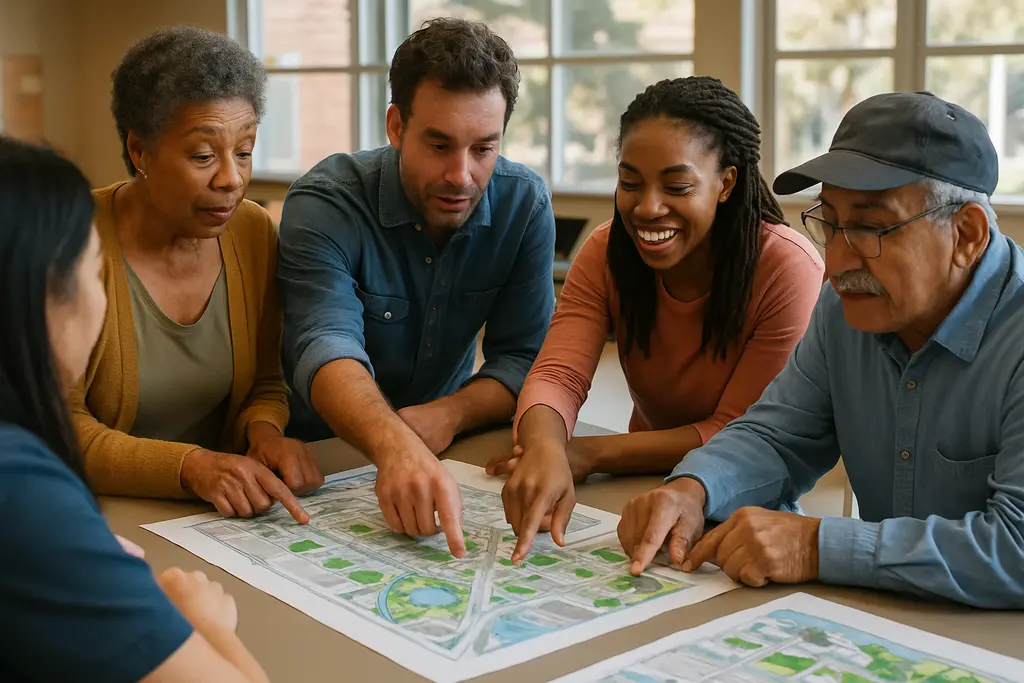
Public participation is shaping green stormwater projects in several U.S. cities, with 2026 public meetings and comment periods giving residents a chance to review drainage plans, ask engineers direct questions, and raise concerns before designs move closer to construction. For neighborhoods that deal with street flooding, ponding near homes, aging pavement, and water-quality problems, the civic value is practical: early input can help public works teams understand how drainage issues affect daily life at bus stops, schools, parks, sidewalks, driveways, and local businesses.
The public process matters because stormwater work is not limited to pipes or underground storage. The research record for this article includes projects that paired flood control with park concepts, bioretention systems, stormwater quality vaults, pavement restoration, water-quality upgrades, and community review. Those choices can affect how public land is used, how construction is phased, how residents receive notice, and how local agencies explain tradeoffs. For community outreach teams, the key lesson is that a meeting notice is not just a calendar item. It is an opening for residents, schools, faith groups, senior programs, and neighborhood associations to share site-specific knowledge before project teams finalize plans.
Why Green Stormwater Projects Need Local Voices
How Green Stormwater Projects Turn Comments Into Choices
Stormwater planning often begins with engineering models, permit needs, funding rules, and site constraints. Public input brings in details that may not appear clearly in a technical file: where water collects after heavy rain, which intersections become hard to cross, which park areas are heavily used by children, and where construction access may affect older adults or people with disabilities. When residents speak early, project teams can test whether design concepts fit the way a block, park, or roadway is used.
Two 2026 meeting examples show how that process worked in different places. The City of Issaquah, Washington, held a hybrid community meeting on July 2, 2026, on early-stage plans for four stormwater quality vaults, with in-person and virtual participation listed in the city calendar notice Issaquah community meeting. The hybrid format mattered because it gave more than one path for residents to hear the presentation and provide comments. That kind of access can help parents, shift workers, transit riders, and residents with mobility limits take part without relying on one meeting room.
The City of Galveston, Texas, hosted a public meeting on July 7, 2026, for the South Shore Drainage Project, which the city said was intended to address stormwater flooding, upgrade drainage, and restore pavement, with city engineers available for questions Galveston project notice. That meeting model is useful for neighborhoods because it connects residents directly with the people who can explain design assumptions, likely construction impacts, and what problems a project is intended to solve.
What Residents Can Bring To A Stormwater Meeting
Residents do not need engineering training to contribute useful information. A household that has watched water cover a curb after each storm may understand timing, depth, and traffic effects better than anyone reading a map from a desk. A school, library, or neighborhood center may know which entrances flood first. A small business may know whether delivery access fails during heavy rain. These details can help agencies compare alternatives and plan outreach before construction begins.
For residents, green stormwater projects are easiest to evaluate when questions are specific. People can ask whether the project is meant to reduce street flooding, improve water quality, slow runoff, restore pavement, add planted areas, or meet several of those goals at once. They can ask which streets or parcels are included, what is outside the project area, how maintenance will be handled, and how the city will share updates after the meeting. Clear questions lead to clearer public records.
What 2026 Outreach Shows About Public Access
Meeting Formats Can Widen Participation
The research record shows several agencies using public-facing formats in 2026. Pasadena, California, held a third public outreach event for the Jefferson Park Stormwater Capture Project Feasibility Study on June 9, 2026, with input requested on conceptual park designs, nature-based improvements, and underground infrastructure options. The same research record says Pasadena had received a $191,180 grant in June 2025 through Los Angeles County’s Safe, Clean Water Program to support public education and community engagement tied to the feasibility study. Those details point to a larger practice: funding for infrastructure planning can include resources for public education, not only design work.
Alexandria, Virginia, held a June 4, 2026, public meeting for the Commonwealth, Ashby, and Glebe Flood Mitigation Project, according to the official project notice summarized in the research. That plan included green infrastructure to improve water quality, along with larger pipelines and a new outfall. The meeting was held in person and virtually. As with Issaquah, the format recognized that public participation improves when agencies reduce barriers to attendance.
Detroit residents also saw a formal comment pathway in 2026. The research record says the City of Detroit published a Combined Notice for the proposed N. Corktown Green Stormwater Infrastructure project, with public comments accepted through August 11, 2026. That notice period has passed as of October 15, 2026, so the civic lesson is retrospective: agencies that publish environmental review records give residents a documented way to raise concerns, ask for clarification, and review materials before decisions move forward. For readers following local drainage work, prior coverage of a Detroit stormwater project offers a related look at how flood-risk reduction and resident follow-up can connect after construction.
Public Comment Works Best Before Designs Are Fixed
Comment opportunities are most useful when they arrive before choices are locked in. At the feasibility-study stage, residents may be able to compare concepts. During environmental review, residents can ask how agencies assessed impacts. During design and permitting, residents may still raise questions about construction staging, communication, access, maintenance, and restoration. Once construction is underway, public input often shifts from shaping the project to reducing disruption.
That timing is why outreach should not rely on one flyer or one meeting. Agencies can make participation stronger by pairing mailed notices with web updates, library displays, school and faith-community contacts, translated materials where needed, and clear instructions for written comments. Community groups can help by sharing verified notices, encouraging residents to submit comments before deadlines, and collecting questions that are grounded in real site conditions.
Practical Steps For Community Outreach Teams
Build A Local Stormwater Question List
Neighborhood organizations, schools, churches, and tenant groups can prepare before the next stormwater meeting by creating a simple question list. The goal is not to oppose or endorse a project before reviewing the facts. The goal is to make sure public agencies hear local experience early enough to use it.
- Map known problem spots: Note corners, alleys, bus stops, parking areas, basements, and park paths where water regularly collects.
- Track timing: Record whether flooding happens during short intense storms, long steady rain, snowmelt, or after drains appear blocked.
- Ask about maintenance: Find out who will maintain plantings, vaults, drains, pavement repairs, and sediment controls after construction.
- Check access needs: Raise concerns about school arrival times, senior housing entrances, disability access, emergency routes, and small-business deliveries.
- Request plain updates: Ask the agency how it will share design changes, construction schedules, and contact information after the meeting.
Community outreach teams can also connect residents to broader civic learning spaces. For those interested in examples of community engagement, the Houston LWS Forum is a related site in the same network offering local engagement resources. The strongest role for partner organizations is to help residents prepare questions, understand deadlines, and use official channels rather than rely on rumors or incomplete summaries.
Public Participation Invited For Future Green Stormwater Infrastructure Projects
The 2026 examples from Issaquah and Galveston, along with the official notices summarized in the research from Pasadena, Alexandria, Detroit, Seattle, Philadelphia, Marin County, and Los Angeles, show a consistent civic pattern: public agencies are asking communities to respond before, during, or shortly after key planning steps. That invitation has value only if residents receive clear information, understand the decision point, and know how to submit useful comments.
For future green stormwater projects, community participation should focus on four practical outcomes: identifying real drainage problems, protecting neighborhood access during construction, improving long-term maintenance planning, and making sure public benefits are explained in plain language. Residents can strengthen the process by attending meetings when possible, using virtual options when offered, reviewing project materials before comment deadlines, and submitting observations tied to specific locations.
Public works agencies still carry responsibility for engineering, permits, budgets, and construction oversight. Community members carry knowledge of how water affects daily life on their blocks. When those two forms of knowledge meet early, stormwater planning can become more responsive, more transparent, and better connected to the people most affected by the work.