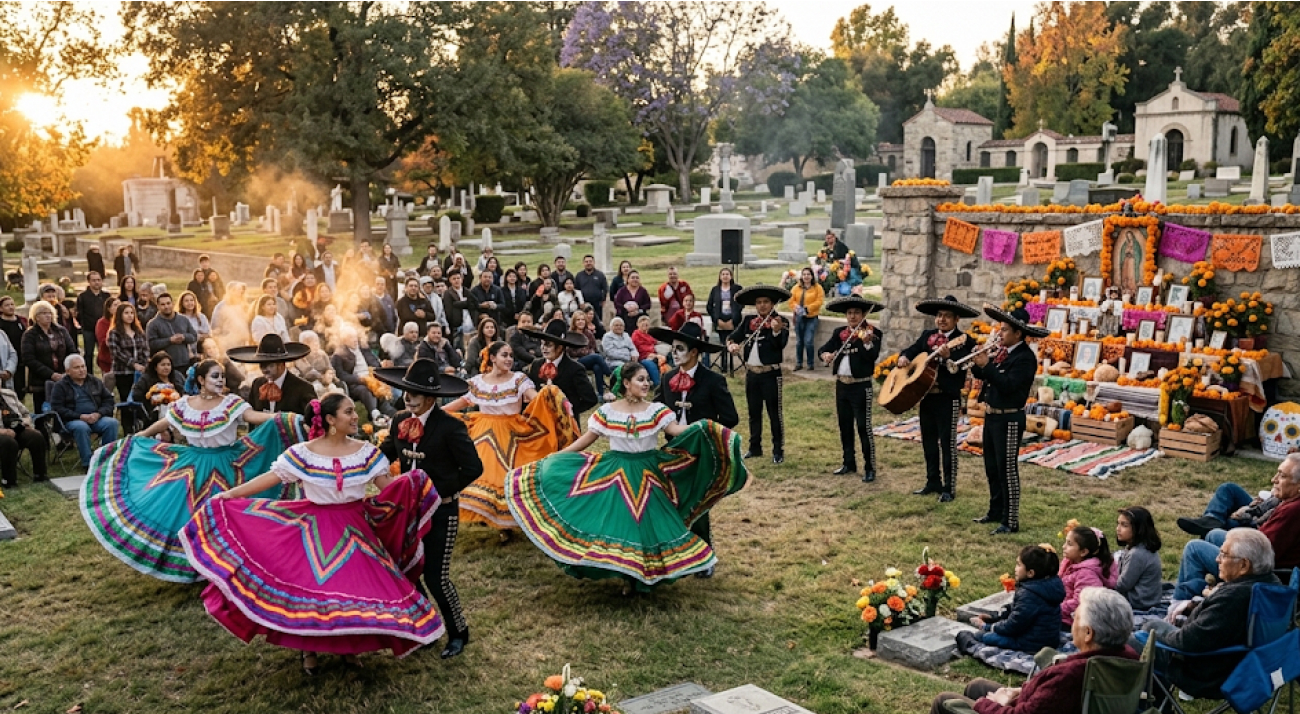
More than 250 people gathered at Our Lady of Hope Cemetery in Brownstown Township on October 24, 2026, for a colorful Día de los Muertos celebration that united Mexican cultural traditions with Catholic prayer, family remembrance, and hope in eternal life.
Music, dancing, flowers, and family photographs transformed a Catholic cemetery in southeast Michigan into a vibrant gathering place on Saturday, October 24, 2026.
At Our Lady of Hope Cemetery, Catholic Funeral & Cemetery Services (CFCS) hosted its annual Día de los Muertos, or Day of the Dead, celebration, welcoming families to honor deceased loved ones through prayer, traditional Mexican music, folk dancing, and a community ofrenda.
More than 250 people attended the event, according to reporting published by Detroit Catholic on October 28, 2026. The celebration featured performances by Ballet Folklórico de Detroit, mariachi music, children’s activities, traditional decorations, and a Catholic Mass celebrated by Father John Herman of St. Frances Cabrini Parish in Allen Park. Detroit Catholic
The gathering took place just ahead of All Saints’ Day on November 1 and All Souls’ Day on November 2, two important observances in the Catholic liturgical calendar.
For Detroit-area Catholics, the event illustrated how cultural heritage and religious faith can come together to remember the dead, strengthen family connections, and express hope in the resurrection of Jesus Christ.
More Than 250 People Gather at Our Lady of Hope Cemetery
The 2026 Día de los Muertos celebration took place from 2 p.m. to 5:30 p.m. at Our Lady of Hope Cemetery, located at 18303 Allen Road in Brownstown Township, Michigan.
Organized by Catholic Funeral & Cemetery Services, the event invited families from across the Detroit metropolitan area to participate in an afternoon of remembrance and community activities.
The cemetery grounds became a setting for cultural expression as attendees enjoyed traditional performances, visited food trucks, participated in crafts, and remembered family members who had died.
2026 EVENT AT A GLANCE
250+
People attending
Oct. 24
Event date in 2026
3.5 hrs
Scheduled celebration
Event details from Detroit Catholic’s October 28 report and the published event listing. Detroit Catholic+1
Unlike occasions when families visit cemeteries primarily for funerals or private moments of grief, Día de los Muertos emphasizes remembrance through both solemn prayer and joyful celebration.
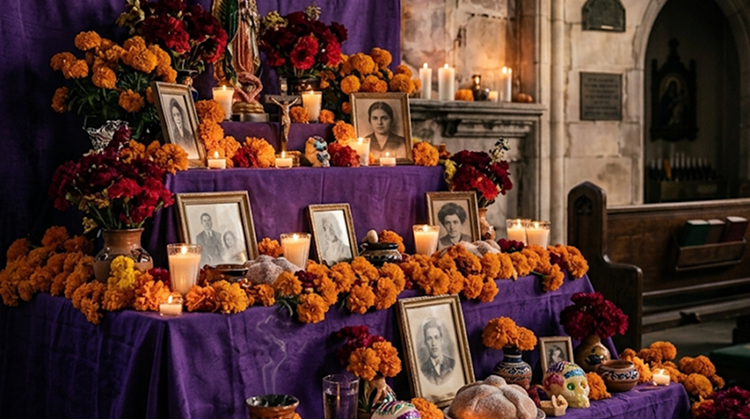
Participants were encouraged to bring photographs of deceased relatives and friends to place on a shared ofrenda, creating a visible expression of the community’s collective memories.
The combination of Catholic worship and cultural traditions demonstrated that remembering the dead does not have to exclude music, beauty, or gratitude for the lives people have shared.
Ballet Folklórico de Detroit Brings Mexican Heritage to the Celebration
One of the most visually striking parts of the afternoon was a performance by Ballet Folklórico de Detroit.
Based in Southwest Detroit, the organization teaches traditional Mexican folk dance to students, including children as young as four years old.
Its performances preserve the distinctive music, clothing, and dance traditions associated with different regions of Mexico.
During the cemetery celebration, dancers wore elaborate traditional costumes and performed energetic routines accompanied by mariachi music.
The colorful skirts, rhythmic movements, and celebratory gritos—expressive calls often heard during Mexican folk performances—created an atmosphere of cultural pride and shared joy.
Ballet Folklórico de Detroit has also performed at the Detroit Institute of Arts and participated successfully in dance competitions around the United States. Detroit Catholic
The group’s participation highlighted the important role cultural organizations play in preserving traditions across generations.
For younger participants, the event offered an opportunity to experience Mexican heritage in a setting that connected family identity with religious practice.
For older generations, the music and dancing could evoke memories of traditions observed by parents, grandparents, and relatives who are no longer living.
In this way, the celebration was not simply an afternoon of entertainment. It was also an opportunity to pass down cultural knowledge and keep family stories alive.
The Community Ofrenda: A Place to Remember Loved Ones
At the center of the celebration was a community ofrenda, a traditional altar or display created to honor deceased loved ones.
Families were invited to contribute photographs, transforming the display into a collective memorial.
An ofrenda often includes several recognizable elements, each carrying cultural or symbolic meaning.
| Traditional element | Common meaning |
|---|---|
| Photographs | Remembering the identities and lives of deceased loved ones |
| Marigolds | Flowers traditionally associated with remembrance and the Day of the Dead |
| Candles | Light, prayer, and remembrance |
| Water and food | Hospitality and traditional expressions of care |
| Papel picado | Decorative cut-paper designs reflecting the fragility of life |
| Sugar skulls | Artistic reminders of mortality and cultural celebration |
| Religious images | Expressions of faith, including devotion to Our Lady of Guadalupe |
The presence of Our Lady of Guadalupe is particularly meaningful for many Mexican Catholic families.
As the patroness of Mexico and the Americas, she holds an important place in Mexican religious identity and Catholic devotion.
The ofrenda creates space for families to remember the personalities, stories, and relationships of people who have died.
It also provides an opportunity for children to learn about relatives they may never have met.
Rather than treating death as a subject that must always remain unspoken, the tradition encourages families to acknowledge loss while celebrating the love and memories that continue.
In a Catholic setting, these cultural practices can accompany prayer for the deceased, although the ofrenda itself is not a sacrament or a required part of Catholic worship.
Father John Herman Celebrates Mass and Calls for Continued Prayer
A central part of the October 24 gathering was a Catholic Mass celebrated by Father John Herman of St. Frances Cabrini Parish in Allen Park.
During his homily, Father Herman reflected on the tradition of visiting cemeteries, caring for graves, and maintaining spiritual connections with deceased relatives and friends.
He emphasized that Catholics are called to remember their loved ones not only through cultural celebrations but also through continued prayer.
His message connected Día de los Muertos with the Catholic understanding of purgatory, God’s mercy, and the hope of eternal life.
According to Detroit Catholic’s coverage, Father Herman encouraged the faithful to continue praying for deceased family members throughout the year, rather than limiting remembrance to a single annual observance. Detroit Catholic
This teaching reflects a longstanding Catholic tradition.
The Church encourages prayers for the faithful departed because Catholics believe that death does not sever the spiritual communion between members of Christ’s Church.
The Mass offered a specifically Catholic dimension to the cultural celebration, bringing families together around the Eucharist and the Church’s prayers for the dead.
For participants, the afternoon combined two complementary experiences: celebrating cherished memories and entrusting deceased loved ones to God’s mercy.
Amanda Owen and Heather Spencer Share Their Family Traditions
For some attendees, the celebration was an opportunity to honor family members buried at Our Lady of Hope Cemetery while participating in traditions already practiced at home.
Amanda Owen, a parishioner of the Basilica of Ste. Anne in Detroit, attended the event with her cousin, Heather Spencer.
Although it was their first time attending the cemetery’s Día de los Muertos celebration, both women were familiar with the tradition of preparing ofrendas.
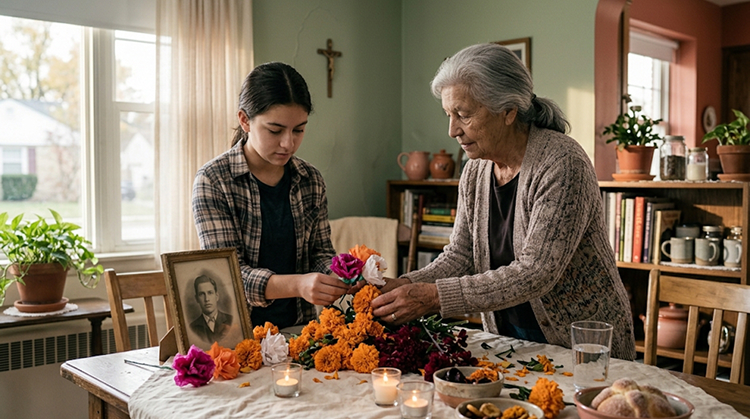
Owen explained to Detroit Catholic that her uncle was buried at Our Lady of Hope Cemetery and that his approaching birthday made the gathering especially meaningful.
Spencer shared that she creates an altar at home each year to remember her mother and father. Detroit Catholic
Their experiences illustrate how Día de los Muertos can connect public celebrations with deeply personal family memories.
A cemetery visit can become more than an occasion to leave flowers at a grave. It can offer time to reflect on a loved one’s birthday, remember shared experiences, and strengthen connections with relatives who are still living.
The participation of Owen and Spencer also shows how traditions can continue in different settings.
An ofrenda prepared at home may be an intimate family practice, while a community celebration allows those memories to become part of a broader expression of solidarity and remembrance.
How Día de los Muertos Connects With All Saints’ Day and All Souls’ Day
Día de los Muertos is traditionally observed on November 1 and 2, overlapping with two significant Catholic celebrations.
Although the observances are related through themes of death, remembrance, and spiritual hope, they are not identical.
November 1: All Saints’ Day
All Saints’ Day honors all the saints in heaven, including those who have not been formally canonized by the Catholic Church.
The celebration emphasizes the Christian belief that holiness is a calling shared by all believers and that the saints remain united with the Church through the communion of saints.
In the United States, All Saints’ Day is ordinarily a holy day of obligation, subject to the applicable liturgical rules when it falls on certain days of the week.
In 2026, November 1 falls on a Sunday, so the celebration coincides with the regular Sunday obligation to attend Mass.
November 2: All Souls’ Day
All Souls’ Day, also known as the Commemoration of All the Faithful Departed, is dedicated to prayer for those who have died.
Catholics traditionally attend Mass, visit cemeteries, pray for deceased relatives, and remember those who may have no one else to pray for them.
The observance is closely associated with the Church’s teaching on purgatory and the purification of souls before entering the fullness of heaven.
Día de los Muertos: Cultural Remembrance and Family Heritage
Día de los Muertos has deep roots in Mexican history and cultural traditions, including Indigenous practices that developed alongside Catholic observances.
Its characteristic flowers, food, artwork, music, and family altars are cultural expressions rather than requirements of Catholic liturgy.
For many Mexican Catholic families, however, the celebration provides a meaningful way to participate in remembrance while also observing All Saints’ Day and All Souls’ Day.
The October 24 gathering in Brownstown Township demonstrated how these traditions can coexist respectfully.
Music and dancing celebrated family heritage, while the Mass directed participants toward prayer and the Christian hope of eternal life.
Our Lady of Hope Cemetery: More Than Six Decades of Catholic History
The setting for the celebration has its own significant history within the Archdiocese of Detroit.
Our Lady of Hope Cemetery was established in 1962 to serve Catholic families in Brownstown Township, Downriver communities, and southwest Detroit.
According to Catholic Funeral & Cemetery Services, the cemetery was developed under the leadership of Father Robert F. Allen, then director of Catholic Cemeteries for the Archdiocese of Detroit.
It was formally blessed and dedicated on September 16, 1962, by Archbishop John Francis Dearden, who later became a cardinal.
The first interment took place on November 5 of that year.
Today, the cemetery occupies approximately 320 acres, with a portion of the property developed for burial purposes. Its history includes more than 26,400 interments, reflecting generations of families connected to the region. Catholic Cemetery, Brownstown MI
The grounds include traditional burial areas, mausoleums, cremation niches, and religious memorials.
Visitors encounter Catholic imagery associated with saints such as St. Joseph, St. Frances Cabrini, St. Anne, St. Anthony, and St. John Paul II.
These features reinforce the cemetery’s role as a place of prayer, sacred memory, and Catholic identity.
By hosting Día de los Muertos, the cemetery also demonstrates how burial grounds can serve living communities through educational, spiritual, and cultural gatherings.
Catholic Funeral & Cemetery Services Builds Community Through Remembrance
Catholic Funeral & Cemetery Services operates Catholic cemeteries in the Archdiocese of Detroit and provides burial, memorial, and related services.
Its mission extends beyond cemetery maintenance and funeral arrangements.
Through events such as Día de los Muertos, the organization helps families maintain connections with deceased loved ones while providing opportunities for prayer and community participation.
The October 24 celebration included activities for multiple generations.
Children participated in crafts and traditional sugar-skull face painting, while adults visited the ofrenda, explored the cemetery, enjoyed performances, and attended Mass.
Food trucks and baked goods contributed to the welcoming atmosphere.
According to Detroit Catholic, participation in the annual celebration has continued to grow, with more than 250 attendees in 2026. Detroit Catholic
This growing interest suggests that the event is becoming an established part of the region’s calendar of Catholic and Mexican cultural activities.
It also reflects the importance of creating community spaces where different generations can share traditions.
For families who have recently experienced a death, these gatherings may provide a gentle way to reconnect with others.
For those remembering loved ones who died many years ago, the celebration offers an opportunity to continue traditions of prayer and remembrance.
Why Praying for the Dead Remains Important in Catholic Teaching
The Catholic Church’s tradition of praying for the dead is rooted in its understanding of the communion of saints.
Catholics believe that the faithful remain spiritually united in Christ, even after death.
This belief is often described through three dimensions of the Church:
- The Church on earth: Christians continuing their earthly pilgrimage of faith.
- The faithful undergoing purification: Those being prepared for the fullness of communion with God.
- The saints in heaven: Those already sharing in eternal life with God.
The Church encourages the living to pray for the dead, particularly through the offering of Masses and personal prayer.
The Catechism of the Catholic Church addresses this practice in paragraphs 1030–1032, explaining the doctrine of purgatory and the importance of prayer for deceased believers.
These teachings help explain why cemetery visits and memorial traditions hold such a significant place in Catholic life.
Remembering the dead is not simply an exercise in nostalgia.
It can also become an expression of faith, charity, and spiritual solidarity.
Father Herman’s homily at Our Lady of Hope Cemetery connected this teaching with the practical experience of families gathering to honor their loved ones.
The central message was that remembrance should continue beyond a single celebration.
How Detroit Catholic Families Can Observe All Souls’ Day
With All Souls’ Day approaching on Monday, November 2, 2026, Detroit-area families have several ways to participate in the Church’s tradition of remembering the deceased.
1. Attend Mass for the faithful departed
Many Catholic parishes celebrate special Masses for All Souls’ Day.
Families can consult their parish schedules or the Archdiocese of Detroit for local liturgical information.
2. Visit a Catholic cemetery
Visiting a family member’s grave provides an opportunity for quiet reflection and prayer.
Families may also clean or care for gravesites, following cemetery regulations.
3. Pray for deceased relatives and friends
Traditional Catholic prayers, including the Eternal Rest prayer and the rosary, can be offered for loved ones who have died.
Families may also request Mass intentions through their local parish.
4. Create a family remembrance space
Photographs, flowers, and other meaningful objects can help families share memories and introduce younger generations to their family history.
For families who observe Día de los Muertos, an ofrenda may be a familiar expression of this tradition.
5. Share stories across generations
Parents and grandparents can tell children about deceased relatives, including their personalities, values, traditions, and contributions to family life.
These conversations help preserve family history and reinforce the importance of remembrance.
6. Offer support to grieving neighbors
Catholic remembrance is also connected to the works of mercy.
A visit, a meal, a thoughtful message, or an invitation to pray together can provide meaningful support to someone experiencing bereavement.
Visiting Our Lady of Hope Cemetery in Brownstown Township
Our Lady of Hope Cemetery – 18303 Allen Rd, Brownstown Charter Twp, MI 48193 – Hours, Directions, Reviews
Our Lady of Hope Cemetery
18303 Allen Road, Brownstown Township, MI 48193
Phone: (734) 285-2155
The cemetery offers traditional burial spaces, mausoleums, memorial areas, and opportunities for prayer and remembrance.
The cemetery’s published seasonal visiting hours are 8 a.m. to 5 p.m. from October 16 through March 14, although visitors should confirm current schedules before traveling. Catholic Cemetery, Brownstown MI
The annual Día de los Muertos celebration is a special event, and its activities and schedule may change from year to year.
A Celebration That Keeps Faith and Family Memories Alive
The October 24 Día de los Muertos celebration at Our Lady of Hope Cemetery brought together more than 250 people for an afternoon that was both festive and deeply meaningful.
Through mariachi music, traditional dance, colorful decorations, children’s activities, and a community ofrenda, families celebrated the memories of people who had shaped their lives.
The Mass celebrated by Father John Herman provided a spiritual foundation, reminding participants of the Catholic tradition of praying for the faithful departed.
For Amanda Owen and Heather Spencer, the gathering offered an opportunity to connect family memories with a shared community experience.
For younger participants, it introduced cultural traditions that can be carried forward into future generations.
And for the broader Catholic community in southeast Michigan, the celebration demonstrated that cemeteries are not only places of sorrow. They can also be places of gratitude, cultural heritage, prayer, and hope.
As All Saints’ Day and All Souls’ Day approach, Detroit’s Día de los Muertos celebration offers a lasting reminder that remembering loved ones is an act of love, praying for the departed is an expression of faith, and honoring family traditions can bring generations together.