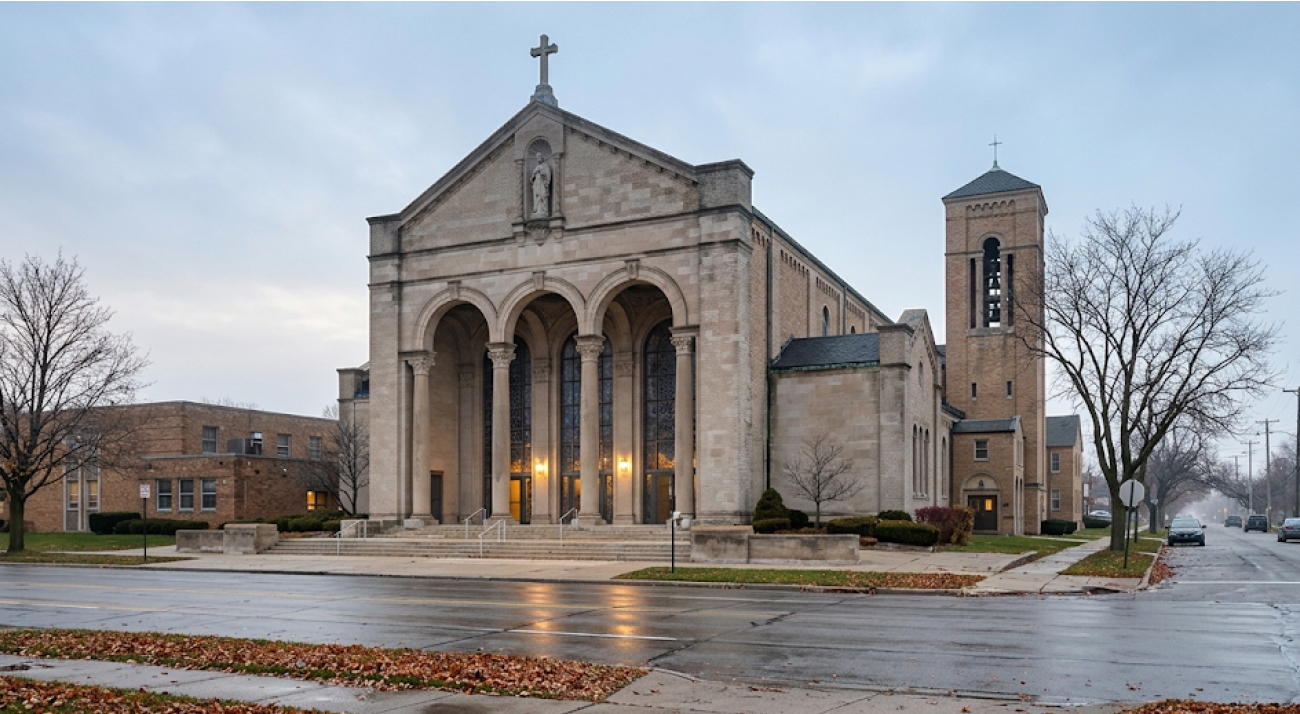
Archbishop Edward J. Weisenburger has ordered St. Jude Catholic Church in northeast Detroit to be removed from sacred use effective November 30, 2026. The decision ends the building’s role as a Catholic worship site, while the parish community will continue at St. Raymond Church.
DETROIT, Michigan — November 10, 2026. Another historic Catholic church in Detroit is preparing to close as the Archdiocese of Detroit moves forward with a formal decision affecting St. Jude Catholic Church, located at 15889 East Seven Mile Road.
On November 5, 2026, the archdiocese announced that Archbishop Edward J. Weisenburger had issued a decree relegating St. Jude Church to secular but not unbecoming use.
The decree was signed on October 27, 2026, and will take effect on November 30, 2026.
Under the decision, St. Jude will no longer function as a Catholic church building. The existing parish community, St. Raymond–Our Lady of Good Counsel Parish, will continue using St. Raymond Church as its principal place of worship.
The announcement is particularly significant because St. Jude had already undergone an administrative merger less than two years earlier.
In January 2025, St. Jude Parish was merged into St. Raymond–Our Lady of Good Counsel Parish. At that time, St. Jude’s church building remained open as an additional worship location.
The new decree completes a further stage of that transition by ending the building’s sacred designation.
St. Jude’s website also advertises a transition Mass on Sunday, November 29, 2026, at 10:30 a.m., one day before the decree takes effect.
The decision comes as the archdiocese considers broader parish restructuring proposals that could substantially change weekend Mass schedules across Detroit. However, St. Jude’s closure is already the subject of a specific decree, unlike many other churches whose futures remain under discussion.
What Does the New Archdiocesan Decree Mean for St. Jude Church?
The Archdiocese of Detroit’s November 5 announcement establishes a definite timeline for St. Jude’s transition out of sacred use.
Unlike a proposed restructuring model, the announcement concerns a formal decree issued by the archbishop.
The decree states that St. Jude Church will be relegated to secular but not unbecoming use, a designation recognized by Catholic canon law.
This means that the building will cease to serve as a Catholic place of worship after the effective date.
The archdiocese also identifies St. Raymond Church as the location where the parish community will continue its religious life.
Key facts about the St. Jude closure
| Detail | Confirmed information |
|---|---|
| Church | St. Jude Catholic Church |
| Address | 15889 East Seven Mile Road, Detroit, MI 48205 |
| Current parish | St. Raymond–Our Lady of Good Counsel |
| Archbishop | Edward J. Weisenburger |
| Decree issued | October 27, 2026 |
| Public announcement | November 5, 2026 |
| Transition Mass advertised | November 29, 2026, at 10:30 a.m. |
| Effective date | November 30, 2026 |
| Continuing worship location | St. Raymond Church |
| Canonical action | Relegation to secular but not unbecoming use |
Is St. Jude already closed?
No. As of November 10, 2026, the decree has not yet taken effect.
The church is preparing for the November 30 change, and its website continues to display a Sunday Mass schedule.
The parish has advertised a November 29 transition Mass, suggesting that parishioners will have an opportunity to gather before the building’s sacred designation ends.
The announcement does not establish whether any additional ceremonies will take place.
Parishioners should consult the official parish bulletin for the latest schedule and transition details.
St. Jude’s Parish Merger Began in January 2025
The November 2026 decree is not the first major administrative change affecting St. Jude.
On December 18, 2024, then-Archbishop Allen H. Vigneron issued a decree merging St. Jude Parish with St. Raymond–Our Lady of Good Counsel Parish.
That merger became effective on January 15, 2025.
The combined community retained the name St. Raymond–Our Lady of Good Counsel Parish.
Importantly, the 2025 decree allowed St. Jude Church to remain open as an ancillary church of the merged parish. Archdiocese of Detroit
This created a distinction between the parish’s administrative status and the continued use of its buildings.
Although St. Jude ceased to exist as a separate canonical parish in January 2025, its church building remained available for worship.
The November 2026 decree now changes that arrangement.
Understanding the two decisions
- December 18, 2024 — Parish merger authorizedArchbishop Allen H. Vigneron issues a decree combining St. Jude Parish with St. Raymond–Our Lady of Good Counsel Parish.
- January 15, 2025 — Merger becomes effectiveSt. Jude becomes part of the larger parish community, while its church building remains open as an ancillary worship location.
- October 27, 2026 — New decree issuedArchbishop Edward J. Weisenburger formally orders St. Jude Church to be relegated from sacred use.
- November 5, 2026 — Decision announcedThe archdiocese publishes the official notice and identifies St. Raymond Church as the continuing parish worship site.
- November 29–30, 2026 — Final transitionA transition Mass is advertised for November 29, followed by the decree’s effective date on November 30.
The sequence demonstrates that the parish merger and the closure of its church building are separate canonical events.
It also illustrates how the consolidation of Catholic communities can unfold gradually rather than through a single decision.
The History of St. Jude Catholic Church: 85 Years of Faith in Detroit
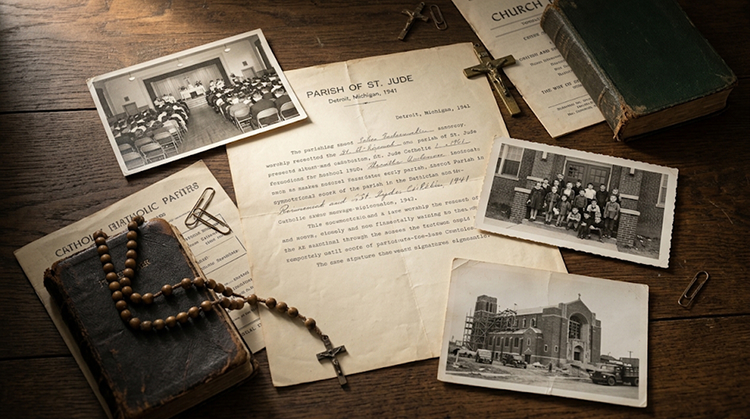
St. Jude Catholic Church has served northeast Detroit since July 8, 1941, when Father John Ording received his appointment to establish the parish.
The community’s first official Sunday Mass took place on July 13, 1941, in the auditorium of Denby High School, with approximately 500 people attending.
At the time, the parish did not yet have a permanent church building.
Its early history reflects the rapid expansion of Catholic communities in Detroit during the city’s industrial era.
As families settled in the surrounding neighborhoods, St. Jude developed from a congregation meeting in a school auditorium into a large parish with its own church, educational facilities, and community organizations.
From a school auditorium to a permanent church
Construction of the parish’s first combined church and school facilities began in November 1941.
The buildings opened for use in June 1942.
On September 14, 1942, St. Jude School welcomed 160 students in grades one through eight.
The school was staffed by Dominican Sisters from Adrian, Michigan, who played an important role in the parish’s educational mission.
Enrollment expanded rapidly.
By 1949, St. Jude had approximately 2,000 parish families, while its school served 800 students.
These figures demonstrate the scale of the Catholic population that once lived in the surrounding neighborhood.
The construction of the current St. Jude Church
In 1952, the parish established a fundraising goal of $250,000 to construct a permanent church and rectory.
The campaign exceeded its target, allowing the community to move forward with the project.
Groundbreaking took place on October 17, 1954.
The lower church was first used for Mass on Easter Sunday in 1956, while the upper church opened for First Communion celebrations on May 12, 1957.
The building was designed by architect Arthur DesRosiers, who created a mid-twentieth-century interpretation of Romanesque church architecture.
Its features include stained-glass windows depicting biblical scenes and saints, a chapel dedicated to St. Jude, and a bell tower positioned near the main church structure.
St. Jude Catholic Church on East Seven Mile Road has been a recognizable religious landmark in northeast Detroit for generations.
A thriving Catholic community during the 1960s
By the early 1960s, St. Jude had become one of the area’s substantial Catholic institutions.
Parish records indicate that the community included more than 3,000 families, while the school had approximately 1,569 students in 28 classrooms.
The parish celebrated its twentieth anniversary in 1961.
During the following years, it adapted to changes introduced by the Second Vatican Council, including reforms to the celebration of Mass and greater participation by lay Catholics.
Saturday evening vigil Masses began in 1969.
These developments demonstrate how St. Jude evolved alongside the wider Catholic Church while maintaining its role as a neighborhood institution.
St. Jude’s Legacy Includes Education, Charity, and Neighborhood Service
Although St. Jude is best known as a place of worship, its history also includes significant educational and charitable activity.
The parish supported Catholic schooling, religious instruction, youth organizations, and assistance for families experiencing hardship.
Its community programs reflected the Catholic understanding that faith should be expressed through service.
Supporting families and vulnerable residents
St. Jude’s historical records describe several initiatives that became part of parish life.
During the 1970s, the community helped sponsor a Vietnamese family through its Christian Service Commission.
A Meals on Wheels program began in 1976.
In later decades, the parish expanded its involvement in the Society of St. Vincent de Paul and other charitable activities.
Programs included assistance for residents in need, religious education, and support for people experiencing bereavement.
The parish also organized social events, festivals, and gatherings that strengthened relationships among Catholic families.
These activities helped establish St. Jude as a community institution rather than simply a building used for Sunday worship. St. Jude Parish
A parish that continued changing with Detroit
Like many Catholic communities established during Detroit’s population growth, St. Jude eventually faced changing neighborhood demographics.
Families moved, school enrollment patterns shifted, and the distribution of Catholic worshippers across the metropolitan area evolved.
The parish continued adapting to these changes.
Its official mission statement emphasizes the Eucharist, religious service, social justice, and respect for the diversity of its members.
The website describes a community committed to sharing its time, talents, and resources for the benefit of others.
These commitments remain relevant as parishioners prepare to worship at St. Raymond Church.
Where Will St. Jude Parishioners Attend Mass After November 30?
The archdiocese has confirmed that St. Raymond Church will remain the parish church of St. Raymond–Our Lady of Good Counsel Parish.
The church is located at 20103 Joann Avenue, Detroit, MI 48205.
Its official website lists Saturday evening, Sunday morning, and weekday Masses.
St. Raymond–Our Lady of Good Counsel Catholic Church
20103 Joann Avenue, Detroit, MI 48205
Published Mass schedule
| Day | Time |
|---|---|
| Saturday vigil | 4:00 p.m. |
| Sunday | 10:30 a.m. |
| Monday–Friday | 8:30 a.m. |
Schedule published on the parish website as of November 10, 2026. Times may change during the transition; confirm before attending.
What will happen to the St. Jude community?
Although the church building will no longer be used for Catholic worship, the parish community itself will continue.
St. Jude parishioners have already been part of St. Raymond–Our Lady of Good Counsel Parish since January 2025.
The upcoming change therefore concerns the location of worship rather than the creation of an entirely new parish.
Parishioners can continue participating in Mass, the sacraments, and community activities through the existing parish structure.
St. Raymond’s website also lists ongoing ministries, including a food pantry, Bible study, and community support activities.
Who Is Leading the Parish During the Transition?
The St. Jude website identifies Father Francis Asomkase, SSJ, as a Josephite priest serving the community.
Born and raised in Nigeria, Father Asomkase entered the Society of St. Joseph of the Sacred Heart and completed his seminary formation in the United States.
He was ordained on May 29, 2010.
Before serving in Detroit, his assignments included ministries in New Orleans, Texas, and Baltimore.
His experience includes parish leadership and the formation of Josephite seminarians.
The Josephites have a longstanding commitment to serving African American Catholic communities, making their ministry particularly relevant to the religious and cultural history of Detroit.
Father Asomkase’s pastoral responsibilities place him among the clergy helping local Catholics navigate a period of significant institutional change. Detroit, MI
What Does It Mean to Relegate a Catholic Church to Secular Use?
The decree affecting St. Jude uses terminology drawn from the Catholic Church’s Code of Canon Law.
A Catholic church building is considered a sacred place when it has been dedicated or blessed for divine worship.
When a diocesan bishop relegates a church to secular but not unbecoming use, its sacred designation ends.
This allows the building to be used for purposes other than Catholic worship, subject to applicable Church requirements.
The phrase does not mean that the building must be demolished.
Canon 1222 and the closure of church buildings
Canon 1222 establishes the legal framework for relegating churches from sacred use.
The canon provides for such decisions in circumstances involving an unusable building or other grave reasons, subject to the requirements applicable to the case.
Depending on the grounds for the decision, these requirements can include consultation with the presbyteral council and consideration of the spiritual welfare of the faithful.
The Archdiocese of Detroit’s public notice confirms that a decree was issued for St. Jude.
However, the brief public announcement does not provide the complete reasoning contained in the certified decree. Vatican+1
It would therefore be inaccurate to attribute the St. Jude closure to a specific financial deficit, structural problem, or attendance figure without additional documentation.
The archdiocese has stated that a certified copy of the decree may be requested from the parish office.
Does the decree mean St. Jude will be demolished or sold?
No such outcome has been confirmed in the official announcement.
Relegation from sacred use is a canonical decision concerning the building’s religious status.
It does not automatically establish a future sale, demolition, redevelopment, or conversion.
The archdiocese has not identified a final future use for St. Jude in its November 5 notice.
Until additional information becomes available, the building’s long-term disposition remains an open question.
St. Jude Is the Second Church in Its Parish to Face Relegation in 2026
The closure of St. Jude follows another significant change within the same parish community.
On May 7, 2026, Archbishop Weisenburger issued a decree relegating Our Lady Queen of Heaven Church in Detroit to secular but not unbecoming use.
That decision became effective on July 1, 2026.
At the time, the archdiocese stated that St. Raymond Church would remain the parish church and St. Jude would continue to be used for certain liturgies.
The November decree now ends the use of St. Jude as an additional worship location. Archdiocese of Detroit
The sequence means that two church buildings associated with the same parish community have been removed from sacred use during 2026.
St. Raymond Church remains the designated parish worship site.
How the parish’s worship locations have changed
| Church | Status as of November 10, 2026 |
|---|---|
| St. Raymond Church | Continuing parish church |
| Our Lady Queen of Heaven Church | Relegation effective July 1, 2026 |
| St. Jude Church | Relegation scheduled for November 30, 2026 |
These changes illustrate the difference between preserving a Catholic parish community and maintaining multiple church buildings.
For parishioners, however, each transition may involve leaving a familiar place where important family and religious events occurred.
How Does St. Jude’s Closure Relate to Detroit’s Wider Parish Restructuring?
The Archdiocese of Detroit is conducting a separate, archdiocese-wide restructuring initiative that is expected to begin implementation in 2027.
The process involves evaluating parish groupings, priest assignments, worship schedules, and the sustainability of church buildings.
Archdiocesan leaders have identified declining Mass attendance, fewer available priests, and the cost of maintaining aging facilities as major concerns.
According to the official restructuring website, the archdiocese once served approximately 1.5 million Catholics and now serves about 900,000. Detroit, MI
Detroit could see major changes to weekend Mass schedules
A November 7 investigation by The Detroit News found that as many as 20 of approximately 39 Catholic churches within Detroit could lose regular weekend Masses under the broader restructuring proposals.
Sixteen would be affected under both models, while four additional churches could be affected under one scenario.
These are draft proposals, not final decisions. AOL
St. Jude’s situation is different because Archbishop Weisenburger has already issued a specific decree with an effective date.
The broader restructuring models remain under review, with final decisions expected in April 2027.
Archbishop Weisenburger emphasizes care for parishioners
In an October 28 statement, Archbishop Weisenburger acknowledged the emotional difficulty of parish changes.
He emphasized that restructuring affects relationships, traditions, and the sense of belonging that Catholics develop within their parishes.
The archbishop also reaffirmed that no final decisions had been made about the broader restructuring proposals.
His comments highlight a central challenge facing the archdiocese: maintaining sustainable Catholic ministry while recognizing the spiritual and personal significance of historic parish communities. Archdiocese of Detroit
Why the Closure Matters for Detroit’s Catholic Heritage
St. Jude’s history reflects several important chapters in Detroit’s development.
Founded in 1941, the parish grew rapidly during the city’s industrial expansion.
Its school educated generations of children, while its religious and charitable programs supported families throughout the surrounding neighborhood.
The current church building represents mid-twentieth-century Catholic architecture and the financial sacrifices of parishioners who helped construct it.
Its stained-glass windows, chapel, and bell tower preserve the artistic and religious identity of the community.
The closure therefore raises questions extending beyond future Mass schedules.
Preserving historical records and religious artifacts
When a Catholic church closes, parishioners may have concerns about sacramental registers, photographs, statues, stained glass, and other materials connected to the building.
The Archdiocese of Detroit’s closed-parishes directory identifies St. Raymond–Our Lady of Good Counsel Parish as the location responsible for St. Jude’s parish records. Archdiocese of Detroit
The future disposition of individual religious objects and architectural features has not been specified in the public decree announcement.
Historic preservation may involve documenting the building, collecting photographs, recording parishioners’ memories, and safeguarding significant artifacts where appropriate.
These efforts can help preserve the story of a community even when its original worship location is no longer in use.
What Should St. Jude Parishioners Know Before November 30?
The immediate priority for parishioners is understanding the transition schedule and the continuing opportunities for worship.
The official St. Jude website advertises a transition Mass on November 29 at 10:30 a.m.
The archdiocese’s decree takes effect the following day.
Parishioners seeking additional information can contact the St. Raymond–Our Lady of Good Counsel Parish office.
The archdiocese also provides a direct contact for questions concerning the decree.
Official contact information
- St. Raymond–Our Lady of Good Counsel Parish Office: 313-527-0525
- Archdiocese of Detroit Chancellor’s Office: chancellor@aod.org
- St. Jude Catholic Church website
- St. Raymond–Our Lady of Good Counsel Parish website
Those seeking the precise canonical grounds for the decision can request a certified copy of the decree from the parish office.
Conclusion: St. Jude’s Church Building Will Close, but Its Catholic Community Continues
The November 30, 2026, closure of St. Jude Catholic Church marks a significant transition for a Detroit religious community established 85 years ago.
From its first Mass at Denby High School in 1941 to the construction of its permanent church in the 1950s, St. Jude became an important center of Catholic worship, education, and charitable service.
Its history includes generations of families, Dominican Sisters, Josephite priests, and parishioners who contributed to the religious life of northeast Detroit.
The new decree issued by Archbishop Edward J. Weisenburger brings the building’s sacred designation to an end.
However, the community will continue within St. Raymond–Our Lady of Good Counsel Parish, where parishioners can participate in Mass and ongoing ministries.
For Detroit Catholics, St. Jude’s transition is another reminder that the city’s religious landscape is changing.
Although the building will no longer serve as a Catholic church after November 30, the history, relationships, and spiritual traditions created there remain part of Detroit’s Catholic heritage.